

Welder Jobs in India: Salary, Skills and How to Apply
Welder jobs are available across India in manufacturing units, construction projects, automotive factories, shipyards, repair workshops and many other workplaces. If you enjoy hands-on work and don't mind learning a practical skill, welding can offer a route into several industries.
The work isn't just about joining two pieces of metal. Employers also look for people who can read basic drawings, follow safety rules, use the right welding process and produce neat, reliable joints. Here's what to know about welder jobs in India, from training and salary expectations to finding openings.
What Does a Welder Do?
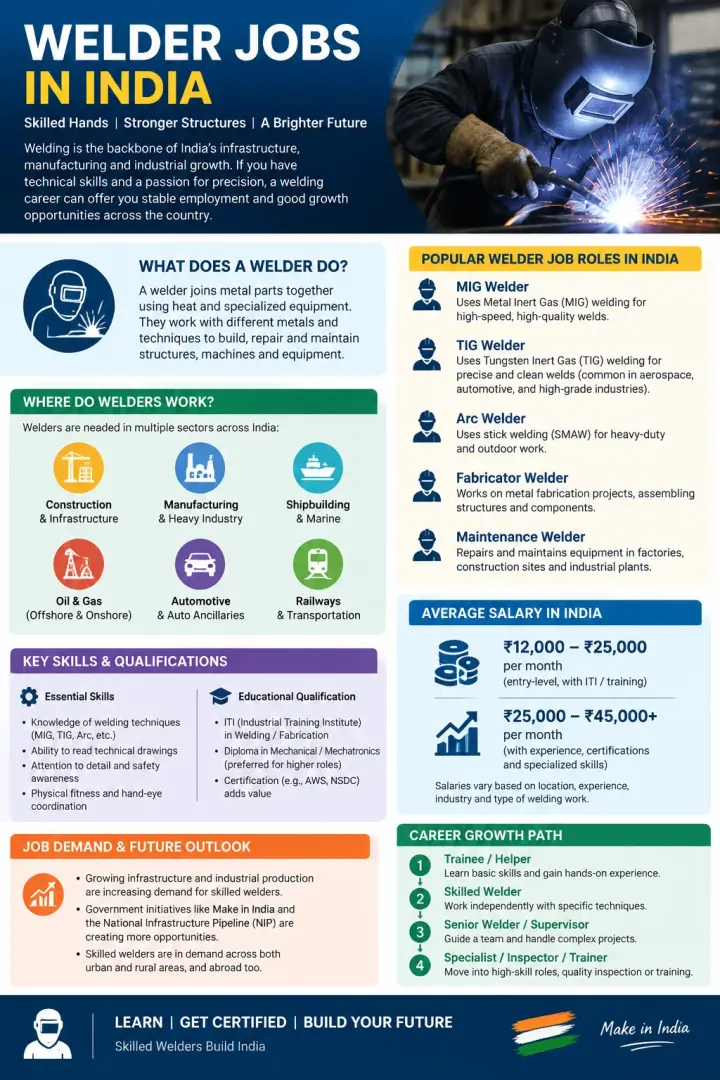
A welder joins or repairs metal parts using heat, pressure or a combination of both. Depending on the job, they may work with mild steel, stainless steel, aluminium or other metals. Some welders spend their days on a factory floor, while others travel to construction sites or work in maintenance teams.
Typical duties include:
- Reading job instructions, measurements and basic fabrication drawings.
- Preparing metal surfaces by cleaning, cutting or grinding them.
- Choosing suitable welding equipment and materials for the task.
- Joining parts using the required welding process and position.
- Checking welds for visible defects and correcting problems.
- Maintaining equipment and following workplace safety procedures.
Job titles can vary. When you're searching, look for welder, MIG welder, TIG welder, arc welder, fabrication welder, pipe welder and maintenance welder. Some openings may also be listed under fitter or fabricator roles, although the duties aren't always the same.
Types of Welder Jobs
Arc welder
Arc welding, often called stick welding or SMAW, is common in fabrication, construction and repair work. It's used in workshops as well as on outdoor sites. A welder needs to control the electrode and produce a sound joint even when the working position is awkward.
MIG welder
MIG welding uses a continuously fed wire and shielding gas. It's widely used in production and fabrication, including automotive and manufacturing work. Job ads may also use the term GMAW. Employers often value welders who can maintain consistent quality while meeting production targets.
TIG welder
TIG welding is often chosen when precision and a clean finish matter. It's used for stainless steel, aluminium and other materials in industries such as food equipment, pharmaceuticals and specialist fabrication. TIG work takes practice, and some roles ask candidates to demonstrate their skills in a trade test.
Pipe and structural welder
Pipe welders work on piping systems in settings such as power plants, refineries and industrial projects. Structural welders join components used in buildings, bridges and other structures. These jobs can require position-specific skills, site experience or qualification tests, depending on the employer and project.
Maintenance and repair welder
Maintenance welders repair worn or damaged metal parts in factories, workshops and equipment yards. The work can be varied: one day might involve repairing a bracket, while another involves working with a larger maintenance team during a plant shutdown.
Welder Salary in India
Welder salaries vary widely by location, experience, welding process and industry. As a rough starting point, a fresher might see full-time offers around ₹12,000 to ₹20,000 per month. A welder with experience may find roles around ₹18,000 to ₹35,000 per month, while specialised or project-based roles can pay ₹35,000 to ₹60,000 or more.
These are illustrative ranges, not guaranteed rates. Some employers pay daily wages or offer overtime, accommodation, transport or other allowances. Others quote a salary that includes certain allowances, so it's worth asking for a clear breakdown. Apprenticeship stipends are different from regular employee salaries and depend on applicable rules and the apprenticeship terms.
Before accepting an offer, check the working hours, weekly rest day, overtime policy, deductions and take-home pay. Minimum wage requirements also vary by location, type of establishment and worker classification. Check the applicable current rules if you're unsure.
Qualifications for Welder Jobs in India
There isn't one qualification that fits every welding job. Some entry-level employers hire candidates with basic practical skills and train them on the job. Others ask for an ITI certificate, an apprenticeship or prior experience with a particular welding process.
Common routes into the trade include:
- ITI training: Many candidates join the Welder trade at a government or private Industrial Training Institute. Course eligibility, duration, fees and admission dates should be checked with the institute or the relevant state admissions authority.
- Apprenticeship: An apprenticeship gives you structured workplace training and can help you build practical experience after a suitable course or as permitted by the programme.
- Short-term skill training: Some training centres offer courses in specific welding processes. Check the practical training hours, assessment method and the value employers place on the certificate before paying.
- On-the-job training: A workshop or employer may take on helpers or trainees who learn under experienced workers. Ask what training and safety equipment will be provided.
Some specialist jobs require a welder qualification test for a particular process, material, thickness or position. Project specifications may refer to standards such as ASME Section IX or AWS codes. A general training certificate doesn't automatically qualify you for every code-based welding job, so read the vacancy requirements carefully.
Skills Employers Look For
Practical ability matters a lot in welding. A certificate can help you get shortlisted, but many employers will also want to see what you can do. These skills are useful across a wide range of jobs:
- Setting up and using equipment for the required welding process.
- Understanding measurements, joint types and basic technical drawings.
- Preparing, aligning and securing parts before welding.
- Recognising common defects such as cracks, porosity and poor fusion.
- Working carefully in different welding positions.
- Using grinders and other tools safely.
- Communicating with supervisors, fitters and quality inspectors.
Honestly, consistency is a big part of the job. A neat weld is useful, but employers also need work that meets the drawing and quality requirements. If you're a fresher, regular practice and feedback from a qualified trainer can make a real difference.
Where to Find Welder Jobs in India
Manufacturing clusters and industrial areas are a good place to start. Openings can be found around cities such as Pune, Chennai, Bengaluru, Hyderabad, Ahmedabad, Surat, Mumbai and Delhi NCR, as well as in smaller industrial towns. Shipyards, infrastructure projects and power plants may hire for specific locations or project periods.
Try several routes rather than relying on one job site:
- National Career Service: Search the government portal at ncs.gov.in for vacancies and career information.
- Apprenticeship listings: Check apprenticeshipindia.gov.in for opportunities and eligibility details.
- Job portals: Search by process, location and experience level. Try terms such as “ITI welder jobs”, “MIG welder jobs” or “TIG welder jobs near me”.
- Company career pages: Look at manufacturers, engineering companies, contractors and fabrication businesses.
- ITI placement cells: Ask your institute about campus drives, employer contacts and apprenticeship openings.
- Local workshops: Visit or contact fabrication units in your area with a short resume and details of your skills.
Keep your search specific. For example, “MIG welder jobs in Pune” may bring up more relevant results than a general search for “jobs in India”. Also check when a vacancy was posted and whether the employer is still accepting applications.
How to Apply for a Welder Job
Start with a simple, accurate resume. You don't need fancy language. Make it easy for an employer to see the welding processes you know and the kind of work you've done.
Include your contact details, location, training, apprenticeship or work history, and any relevant certificates. Mention processes such as SMAW, MIG or TIG only if you can actually use them. You can also list materials, welding positions, drawing-reading skills and tools you've worked with.
If you're a fresher, add practical projects from your ITI course or training centre. For example, describe the material, joint type and process you used. Avoid claiming experience you don't have; a trade test will quickly show what you're comfortable doing.
For an interview or practical test, take copies of your documents and ask beforehand whether you need to bring any personal protective equipment. Follow the test instructions, check your setup and don't rush past safety checks just to finish quickly.
Safety on the Job
Welding can expose workers to burns, electric shock, harmful fumes, intense light and fire hazards. A responsible employer should provide suitable safety procedures, training and protective equipment for the work.
Depending on the task, protection may include a welding helmet with the correct shade, safety glasses, gloves, protective clothing and safety footwear. Good ventilation or fume extraction is important, and respiratory protection may be needed where other controls aren't enough.
Gas cylinders, electrical leads and nearby flammable materials also need proper handling. Confined spaces require particular care, including appropriate permits, monitoring and emergency arrangements. If a workplace asks you to ignore basic safety rules, that's a serious warning sign.
Career Growth for Welders
Many welders begin as trainees or helpers and build skills through practice. With experience, you could move into a more specialised process, pipe or structural work, team supervision, fabrication planning or quality-related roles. Each move has its own requirements; inspection jobs, for example, may need additional education, experience or certification.
To improve your options, keep a record of your training and the processes you've used. Ask for feedback after trade tests, learn to read drawings more confidently and consider targeted training that matches the jobs you want. There's no need to collect certificates just for the sake of it.
How to Avoid Job Scams
Be cautious if a recruiter promises a guaranteed job, asks for a large upfront payment or refuses to share the company name and work location. Verify the opening through the employer's official contact details before sending sensitive documents or money.
For overseas welder jobs, check the employer, contract, visa process and whether the recruiting agent is authorised. Don't rely only on a message or social media post. Keep copies of any offer letter and make sure you understand the salary, working hours, accommodation and deductions before agreeing.
Frequently Asked Questions About Welder Jobs
Can a fresher get a welder job in India?
Yes. Workshops, manufacturers and contractors may hire trainees or entry-level welders. ITI training, an apprenticeship and solid practical skills can help, though requirements differ by employer.
Is an ITI certificate compulsory for every welder job?
No. Some employers accept practical experience or other training, while others specifically ask for an ITI certificate. Specialist jobs may have additional qualification or trade-test requirements.
Which welding process pays the most?
There isn't a single process that always pays the most. Pay depends on the project, location, material, working conditions and the welder's ability to meet the required standard. Specialised TIG, pipe and other demanding roles may offer higher pay, but they often require more training or testing.
Do welders have to travel for work?
Not always. Factory and workshop jobs may be based in one place, while construction, shutdown and project roles can involve travel or temporary relocation. Ask about the work location and duration before accepting an offer.
Whether you're starting at an ITI or looking for your next role, focus on practical skills, safe working habits and jobs that match your experience. A clear resume and a careful search can help you find an opportunity that's right for you.