

Welder Jobs in the United States: Pay, Skills, and How to Get Started
Welding can be a good fit if you like hands-on work and want a career where you can see what you’ve built. Welders help make and repair everything from building frames and bridges to trucks, pipelines, and manufacturing equipment.
There’s no single route into the trade. Some people start at a technical school, while others learn through an apprenticeship or an entry-level shop job. Here’s what to know about welder jobs in the United States, including common specialties, pay, training, and where to look for work.
What Does a Welder Do?
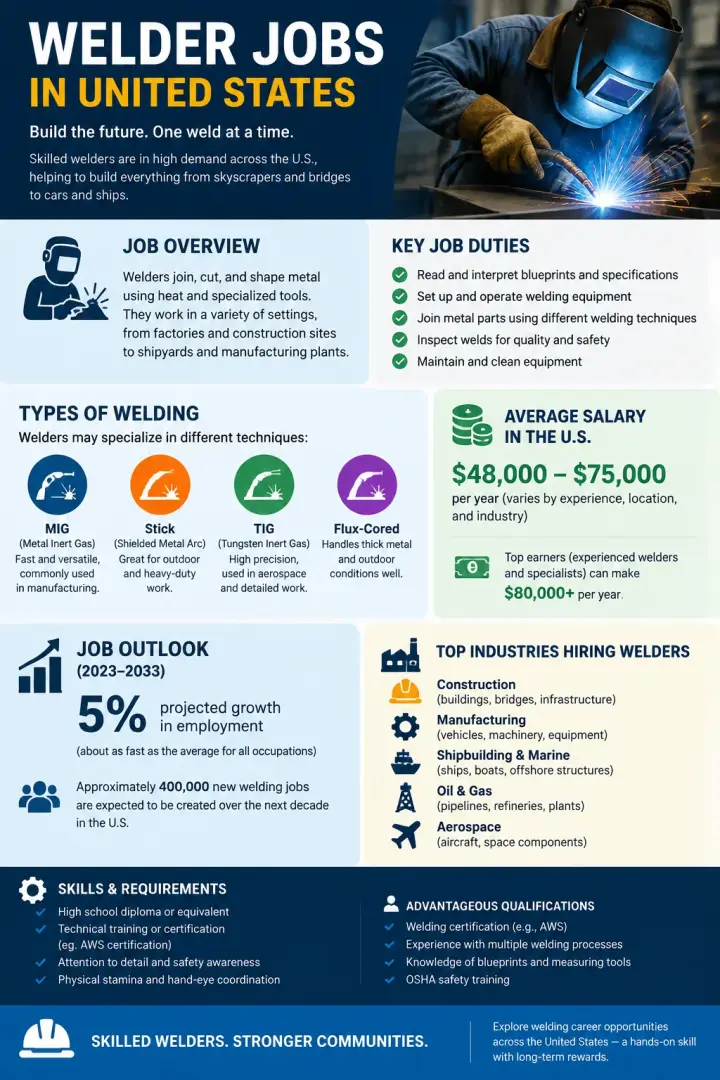
A welder joins or repairs metal parts using heat and, in some cases, pressure. The job is more than striking an arc, though. A typical shift might include reading drawings, measuring and cutting material, setting up equipment, and checking finished welds for defects.
Depending on the employer, a welder may also:
- Use grinders, saws, clamps, and other fabrication tools.
- Choose welding settings and filler materials for the job.
- Follow a welding procedure and workplace safety rules.
- Work with steel, aluminum, stainless steel, or other metals.
- Repair worn or damaged parts.
- Document work or prepare it for inspection.
Some jobs are based in one shop with a regular schedule. Others involve outdoor construction sites, shutdown projects, shipyards, or travel. Read the job description carefully: two positions with the same title can have very different day-to-day routines.
Types of Welder Jobs
Job listings often name a welding process, an industry, or both. These are some of the most common options.
MIG Welder
MIG welding, also called gas metal arc welding, uses a continuously fed wire electrode. You’ll find MIG welder jobs in manufacturing, fabrication shops, and automotive work. It’s often one of the first processes taught to beginners, although producing consistent, high-quality welds still takes practice.
TIG Welder
TIG welding, or gas tungsten arc welding, is known for precision. It’s used on materials such as stainless steel and aluminum, often where appearance or tight tolerances matter. TIG positions are common in specialty fabrication and some aerospace, food equipment, and medical equipment work.
Stick Welder
Stick welding, also called shielded metal arc welding, uses a consumable electrode coated in flux. It’s used in construction, maintenance, and repair, including outdoor work. Employers may look for stick welders who can work in different positions and follow specific project requirements.
Flux-Cored Arc Welder
Flux-cored arc welding uses a tubular wire. Depending on the wire, the process may use shielding gas or be self-shielded. It’s used in structural work, heavy fabrication, and shipbuilding. A listing may call for flux-core experience alongside MIG or stick skills.
Pipe Welder
Pipe welders join and repair piping used in industrial facilities, power plants, and other settings. The work can require welding in tight spaces or difficult positions. Employers often require a hands-on weld test and experience with the specific pipe, materials, and procedures used on the project.
Structural Welder and Fabricator
Structural welders work on metal components for buildings, bridges, and other structures. A welder-fabricator may spend just as much time measuring, cutting, fitting, and assembling parts as welding them. Blueprint reading and accurate layout skills can make a big difference in these roles.
How Much Do Welders Make?
Welder pay varies widely by location, experience, industry, schedule, and the type of work. An entry-level production welder in a local shop may earn less than an experienced pipe welder on a demanding travel assignment. Overtime can also change a paycheck considerably.
For a reliable starting point, check the U.S. Bureau of Labor Statistics Occupational Outlook Handbook entry for welders, cutters, solderers, and brazers. Its wage figures cover a broad occupation group, so compare them with current local job postings for the specialty you want.
When comparing offers, look beyond the hourly rate:
- Overtime: Ask how often it’s available and whether it’s mandatory.
- Travel pay: Find out whether travel time, lodging, or mileage is covered.
- Per diem: Ask when it applies, what it covers, and whether it’s included in the advertised pay.
- Benefits: Compare health insurance, retirement contributions, paid time off, and training support.
- Schedule: Night shifts, weekend work, and project shutdowns may come with different rates or demands.
One note: if an ad promises unusually high weekly earnings, check how many hours you’d need to work to earn that amount. A large number based on a long workweek isn’t the same as a high base hourly rate.
How to Become a Welder
You don’t necessarily need a four-year college degree to become a welder. You do need practical skills, and many employers want proof that you can perform the work safely and consistently.
1. Finish High School or Earn an Equivalent Credential
Many employers and training programs prefer a high school diploma or GED. Math, shop, and blueprint-reading classes can be useful. Requirements vary, so don’t assume every opening has the same education rules.
2. Choose a Training Route
Community colleges, trade schools, unions, and employers may offer welding training. Programs vary in length, cost, and how much time students spend practicing. Before enrolling, ask what processes the course covers, what equipment you’ll use, and whether testing fees or protective gear are included.
An apprenticeship is another option. These programs generally combine paid on-the-job training with classroom instruction. Openings and entry requirements depend on the program, and some apprenticeships are competitive.
3. Practice and Build Your Skills
Employers care about what you can do with a torch, not just what’s on a certificate. Practice following instructions, preparing joints, controlling the weld, and inspecting your own work. If possible, get feedback from an experienced instructor or supervisor.
4. Consider Certifications and Qualification Tests
Some employers require a welder to pass a test for a particular process, material, position, or procedure. The American Welding Society offers certification programs, including the Certified Welder program, and also publishes welding codes used in industry.
Be careful with the wording in job ads. A company may ask for a qualification to a specific code or procedure rather than a general certificate. Before paying for a test, ask employers which credential or qualification they actually require. A certification earned in one setting doesn’t automatically qualify you for every welding job.
5. Apply for Entry-Level Work
Look for titles such as entry-level welder, welding trainee, production welder, or welder helper. A helper role may involve moving materials, preparing parts, and assisting experienced workers. It can be a way to learn how a shop or jobsite runs, though the amount of welding you’ll do depends on the employer.
Skills Employers Look For
A strong weld matters, but it’s only part of the job. Employers commonly look for:
- Welding ability: Experience with the processes and materials listed in the opening.
- Blueprint reading: Understanding dimensions, weld symbols, and assembly instructions.
- Measurement and layout: Using tape measures, squares, and other tools accurately.
- Fit-up and fabrication: Preparing and positioning parts before welding.
- Attention to detail: Spotting problems before they become costly repairs.
- Reliability and communication: Showing up on time, asking questions, and coordinating with the team.
Physical requirements matter too. Some jobs involve lifting, standing for long periods, climbing, or working in awkward positions. Check the listing and ask about the actual work environment during the interview.
Where to Find Welder Jobs
Start with major job boards, local staffing agencies that specialize in skilled trades, and the career pages of manufacturers, contractors, and fabrication shops. You can also check union apprenticeship programs and your state’s workforce agency.
Try searches that match both the trade and the location or process you want, such as:
- Welder jobs near me
- Entry-level welder jobs
- MIG welder jobs in Texas
- TIG welder jobs in California
- Pipe welder jobs with travel
- Welder fabricator jobs
- Welding apprenticeship near me
Don’t overlook smaller employers. A local metal shop may not have a polished recruiting page but could still be hiring. A short, professional call or email asking about openings can be worthwhile.
How to Apply and Prepare for a Weld Test
Keep your resume straightforward. List the processes you know, the metals you’ve worked with, relevant training, and any qualifications. If you’ve worked from blueprints or used shop equipment, include that too. Beginners can list school projects and supervised practice without presenting them as paid work experience.
Many employers use a weld test during hiring. Ask ahead of time which process, material, joint, and position will be involved, along with what protective equipment you should bring. Review the instructions, prepare the material carefully, and don’t rush. If something is unclear, ask before you start.
It’s also worth asking about the schedule, expected overtime, safety practices, and opportunities to learn new processes. A job that helps you build skills can be valuable early in your career, even if it isn’t your final destination.
Safety on the Job
Welding exposes workers to hazards including fumes, radiation from the arc, burns, electric shock, fire, and noise. Employers should provide appropriate training and controls for the work. Depending on the task, those controls can include ventilation, protective clothing, eye and face protection, and properly selected respiratory protection.
Confined spaces and work around flammable materials call for additional precautions and procedures. If you’re unsure whether a setup is safe, stop and ask your supervisor. OSHA’s welding, cutting, and brazing resources are a useful place to learn more about workplace requirements.
Frequently Asked Questions About Welder Jobs
Can I get a welding job with no experience?
Yes, some employers hire trainees or helpers with little or no experience. You may improve your chances by completing an introductory course, practicing basic welds, and showing that you’re ready to learn. Some entry-level positions still require a practical test.
Do all welders need to be certified?
No. Requirements depend on the employer and the work. Some jobs require a specific certification or qualification test; others focus on shop experience and a hiring test. Check the listing and ask the employer if the requirement isn’t clear.
Is welding a good career?
It can be, especially if you enjoy practical work and are willing to keep learning. The trade offers different paths, from steady shop work to travel-heavy industrial projects. The physical demands, working conditions, and schedules vary, so it’s worth exploring a few specialties before choosing a direction.
Where can experienced welders advance?
Experienced welders may move into specialized fabrication, supervision, training, quality control, or inspection. Some inspection credentials have their own education, experience, and examination requirements. Others choose self-employment, though running a welding business also means handling equipment costs, insurance, and finding customers.
Getting Started With Your Search
Pick a few local welder job listings and compare their requirements. You’ll quickly see which processes, tests, and skills employers in your area ask for most. Then choose training or practice that matches those openings. Honestly, a focused plan is more useful than collecting credentials without knowing whether local employers need them.