

Welder Jobs in Canada: Pay, Skills and How to Get Hired
Welding can be a hands-on, rewarding career if you like making things, solving practical problems and seeing the results of your work. In Canada, welders help build and repair everything from truck frames and farm equipment to pipelines, bridges and industrial machinery.
There isn't just one kind of welder job, either. You might work indoors at a fabrication shop, travel between construction sites or join a maintenance team at a mine. Some jobs offer regular weekday hours, while others involve shifts, overtime or time away from home.
Here's what to know about finding welder jobs in Canada, including qualifications, pay, where to look and what employers typically expect.
What Does a Welder Do?
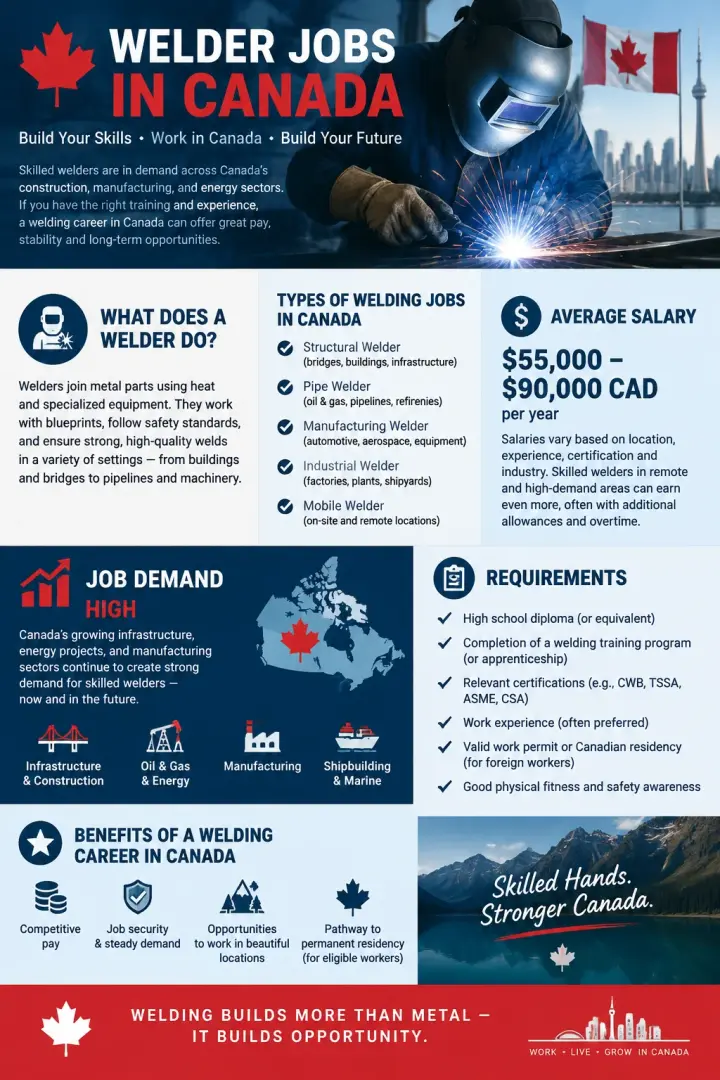
Welders join and repair metal components using heat and specialized equipment. The work can involve steel, stainless steel, aluminum and other materials, depending on the job.
A welder's day often includes more than welding itself. You might read drawings, measure and cut material, prepare joints, set up equipment and check finished work for defects. Some roles also involve fitting parts together before welding or repairing equipment on-site.
Common welding processes you'll see in Canadian job ads include:
- GMAW or MIG welding: Often used in fabrication shops and manufacturing.
- GTAW or TIG welding: Common where a precise, clean weld is needed, including some stainless steel and aluminum work.
- SMAW or stick welding: Frequently used in construction, maintenance and outdoor work.
- FCAW or flux-cored welding: Used in fabrication, structural work and other industrial settings.
You don't need to master every process to start. Many employers look for someone who's strong in the processes used at their particular shop or job site.
Types of Welder Jobs in Canada
Job titles can tell you a lot about the kind of work involved. These are some of the roles worth searching for.
Production Welder
Production welders usually work in manufacturing or fabrication shops. The job may involve making similar parts repeatedly, using jigs and meeting production targets. It can be a good way to build consistency and speed.
Welder-Fitter
A welder-fitter typically measures, cuts and assembles parts before welding them. Employers often want candidates who can read blueprints and work accurately with different tools and equipment.
Structural Welder
Structural welders work on steel components used in buildings, bridges and other structures. Depending on the role, work may be done in a shop or on a construction site, sometimes at heights.
Pipe Welder
Pipe welding jobs can involve industrial facilities, energy projects and other systems that carry liquids or gases. These positions may require specific welding qualifications and tests, particularly when the work must meet strict codes.
Maintenance and Repair Welder
Maintenance welders repair machinery, vehicles or equipment. The work often calls for troubleshooting skills because the problem isn't always obvious until you inspect the damaged part.
How Much Do Welders Earn in Canada?
Welder pay varies quite a bit by location, experience, industry and the type of work. As a broad guide, you may see experienced welder postings around $25 to $45 an hour, with some jobs paying outside that range. Apprentice and entry-level wages can be lower, while specialized, remote or demanding positions may pay more.
Treat any broad range as a starting point, not a guaranteed rate. The advertised number may not tell the whole story. Check whether a job also offers:
- Overtime pay or shift premiums.
- Health benefits and a pension.
- Travel allowances, accommodation or camp work.
- Paid training and certification support.
- Union wages and benefits, where applicable.
For current local wage information, search for welders on the Government of Canada's Job Bank and compare its wage data with recent postings in your area. Make sure you're comparing similar roles: a shop production job and a remote pipe welding job can have very different pay structures.
Requirements for Welder Jobs in Canada
Requirements depend on the province or territory, the employer and the type of welding. Some entry-level employers hire people with limited experience and provide training. Other jobs require a completed apprenticeship, trade certification or proof that you can pass a specific welding test.
Education and Apprenticeship
A high school diploma is commonly requested, and courses in math, shop or blueprint reading can be useful. Some people enter the trade through a college welding program; others find an employer willing to hire and train them as an apprentice.
An apprenticeship combines paid work experience with technical training. You generally need an employer who will provide the required workplace experience, along with registration through the relevant provincial or territorial apprenticeship authority. Program length and requirements vary, so check the rules where you plan to work.
Trade Certification and Red Seal
Trade certification requirements aren't identical across Canada. In Alberta, welding is a compulsory certification trade, which means workers generally need to meet the province's certification or apprenticeship requirements. Rules and permitted pathways can be specific, so check with Alberta's apprenticeship authority before accepting work.
In other provinces and territories, certification may be voluntary, though employers can still ask for it. Quebec has its own qualification rules, especially for construction work, so check with the relevant provincial authorities.
Qualified welders may also pursue the Red Seal endorsement by passing the interprovincial Red Seal exam. It can help demonstrate that your skills meet a recognized national standard, but it's not a substitute for checking local rules or an employer's job-specific requirements.
Welding Tests and Additional Qualifications
Even with a trade certificate, you may need to complete a practical weld test for a particular employer, process, position or material. Some jobs also call for Canadian Welding Bureau qualifications, code-specific testing or safety tickets.
Read the posting closely. A requirement for a particular welding qualification isn't necessarily the same thing as a provincial trade certificate.
Skills Employers Look For
Good welding takes steady hands, but there's more to the job than laying a clean bead. Employers often value people who can work safely, follow instructions and catch problems before they become expensive repairs.
- Ability to read drawings, blueprints and welding symbols.
- Accurate measuring, cutting, fitting and joint preparation.
- Experience with the welding processes and metals used by the employer.
- Equipment setup, adjustment and basic troubleshooting.
- Attention to weld quality and inspection requirements.
- Safe use of grinders, cutting tools and personal protective equipment.
- Communication, reliability and the ability to work with a team.
If you're new to the trade, include relevant school projects, shop work or mechanical experience on your resume. Be clear about what you've actually done rather than claiming skills you haven't had a chance to practise.
Where to Find Welder Jobs in Canada
Welders are hired across the country, but opportunities change with local construction, manufacturing and industrial activity. Search in your own area first, then consider whether you're open to relocating, commuting or working away from home.
Useful places to look include:
- Job Bank, for Canadian job postings, wage information and occupational profiles.
- Provincial and territorial apprenticeship websites, for training and registration information.
- Company career pages, especially fabrication shops, manufacturers and industrial contractors.
- Union hiring halls and local trade organizations.
- College career centres, job fairs and local employment services.
- General job boards and staffing agencies that recruit skilled tradespeople.
Try searching for more than just welder jobs. Terms like welder-fitter, MIG welder, TIG welder, production welder, apprentice welder and welding technician can turn up different openings. Add your city or province, and check the duties before applying because job titles aren't always used consistently.
How to Apply for a Welding Job
A useful welding resume makes it easy for an employer to see what you can do. Put your location and contact details at the top, then list your relevant experience, training and credentials.
For each role or project, mention the processes, materials and equipment you used. If you worked from blueprints, performed fitting or completed inspection checks, say so. Include your apprenticeship status and any current qualifications, along with their details where relevant.
For example, instead of writing that you have welding experience, you could explain that you used MIG welding to assemble mild-steel components in a fabrication shop, provided that's accurate. Specific details give an employer a better picture of your experience.
Before an interview, ask whether there's a practical test and what it involves. You may need to bring your own protective equipment, though the employer should explain its site and safety requirements. Review the job posting and be ready to talk honestly about the work you're confident doing and where you still need training.
Working Conditions and Safety
Welding can be physically demanding. Depending on the site, you may stand for long periods, lift materials, work in awkward positions or deal with heat, noise and outdoor weather. Some jobs require travel or shift work, so it's worth asking about the schedule before you accept an offer.
Safety matters every day. Welding fumes, sparks, ultraviolet radiation and electric shock are among the hazards workers may face. Employers and workers need to follow applicable safety requirements, including suitable ventilation, protective clothing, eye protection and safe equipment practices. Some work may also require respiratory protection, hot-work permits, fall protection or confined-space procedures.
During an interview, it's reasonable to ask about training, ventilation, protective equipment and how the company handles site safety. A good employer should be able to explain its approach.
Can Foreign Workers Apply for Welder Jobs in Canada?
Foreign-trained welders can look for Canadian opportunities, but a job offer alone doesn't automatically give someone permission to work. Depending on the situation, a work permit may be required, and an employer may need a Labour Market Impact Assessment unless an exemption applies.
You'll also need to check whether your training and experience meet provincial or territorial trade requirements and the employer's welding standards. An employer may ask you to document your experience or complete a practical test.
Immigration programs and eligibility rules can change. Check Immigration, Refugees and Citizenship Canada for current work permit and immigration information, and contact the trade authority in the province where you want to work. Be cautious of anyone promising a guaranteed visa or charging you for a job offer.
Welder Jobs in Canada: Frequently Asked Questions
Can I get a welder job without experience?
It's possible to find an entry-level position or apprenticeship, although some employers prefer candidates who have completed basic welding training. A college program, pre-apprenticeship course or relevant shop experience can help you build practical skills and meet potential employers.
Do I need a Red Seal to work as a welder?
Not always. Requirements depend on the province or territory and the job. The Red Seal endorsement can be valuable, but you should check both local trade rules and the qualifications listed by the employer.
Are welder jobs available across Canada?
Yes, welding work exists in many regions and industries, from manufacturing and construction to equipment repair. The number and type of openings vary over time, so check current local postings rather than assuming every area has the same demand.
Is welding a good career choice?
It can be a good fit if you enjoy practical work, take safety seriously and are willing to keep developing your skills. Before choosing a path, compare local wages, training costs and working conditions. Talking to an apprenticeship office or visiting a training provider can also help you decide what kind of welding work suits you.