


Restaurant jobs can be a first step into the workforce, a flexible way to earn money, or the start of a long-term career. Whether you like talking to people, cooking under pressure, or keeping a busy operation organized, there's probably a role that fits your strengths.
There's also a lot of variety. A neighborhood café, a hotel restaurant, and a busy fast-food location can offer very different schedules, pay structures, and paths for advancement. Here's what to know about restaurant jobs in the United States, including common positions, how pay works, and how to find a job that's right for you.
What kinds of restaurant jobs are available?
Most restaurants divide work between the front of house, where employees interact with guests, and the back of house, where food is prepared and the kitchen is kept running. Smaller businesses may ask employees to cover several duties.
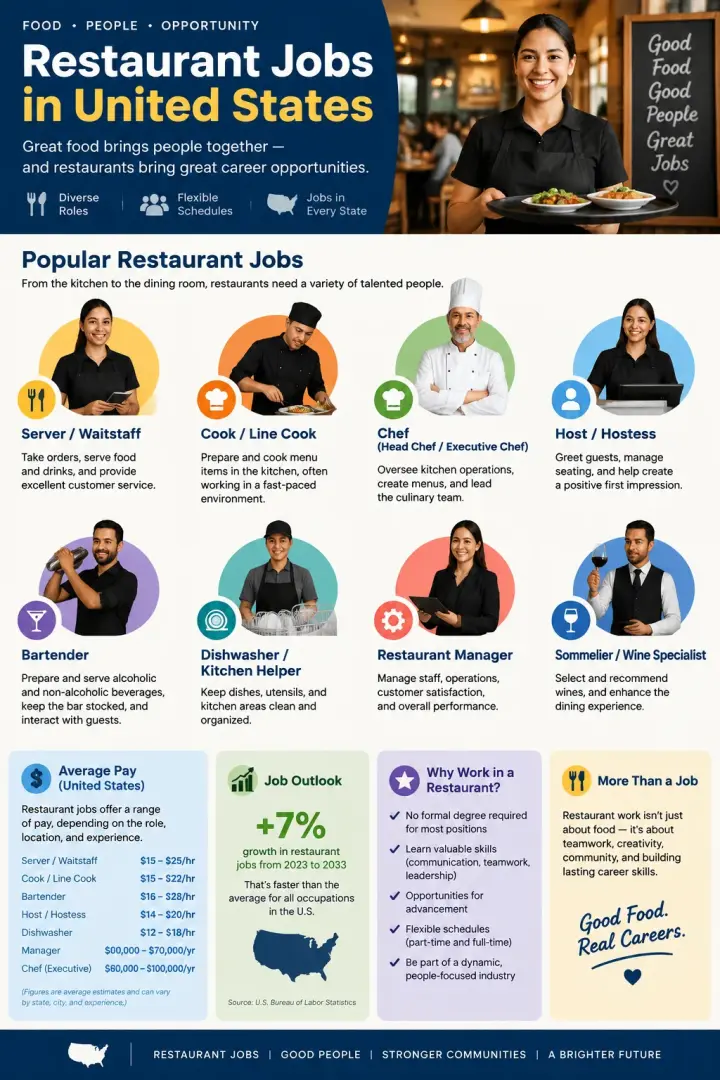
Server
Servers take orders, answer questions about the menu, deliver food and drinks, and help guests throughout their meal. They also handle payments and may set tables or clean their sections. It's a people-focused job that calls for a good memory, patience, and the ability to stay calm when things get busy.
In many U.S. restaurants, servers earn tips in addition to an hourly wage. Earnings can change quite a bit depending on the location, shift, restaurant prices, and tip-sharing rules.
Host or hostess
Hosts greet guests, manage waitlists, answer phones, and help seat tables. They're often the first person a customer sees, so a friendly approach goes a long way. Hosting can be a good entry-level restaurant job, although a busy Friday night can be more demanding than it looks.
Bartender
Bartenders prepare drinks, serve customers, check identification, and keep the bar stocked and clean. Some also handle food orders. The job can pay well in the right setting, but it often involves late nights and weekend shifts.
Rules for serving alcohol vary by state and sometimes by local jurisdiction. Employers may also require alcohol-service training, so check the requirements before applying.
Line cook or prep cook
Prep cooks get ingredients ready by chopping vegetables, making sauces, and completing other tasks before service. Line cooks prepare dishes during service, often working at a specific station such as the grill or fryer.
Kitchen work can be hot, physical, and fast-paced. It's a solid option if you enjoy working with your hands and prefer a job that doesn't revolve around customer interaction. Some restaurants train beginners, while others look for previous cooking experience.
Dishwasher
Dishwashers clean dishes, utensils, and kitchen equipment, and may also help with trash, deliveries, or basic food prep. It's often an entry-level position, but it's an important one: when the dish area falls behind, the whole kitchen feels it. The work usually involves standing for long periods and handling wet or heavy items.
Food runner or busser
Food runners bring dishes from the kitchen to tables. Bussers clear and reset tables, refill water, and help keep the dining room moving. These jobs can be a useful way to learn how a restaurant works before moving into a server position. Depending on the restaurant and applicable law, employees may receive a share of tips.
Restaurant manager or shift supervisor
Managers and supervisors coordinate staff, solve customer problems, handle scheduling, monitor costs, and make sure the restaurant follows food safety procedures. A shift supervisor may oversee a single shift, while a general manager is responsible for the broader operation.
These roles usually require experience, though some employers offer management training programs. They're a good fit for people who like leading a team and making decisions under pressure.
How much do restaurant jobs pay?
Restaurant pay depends on the job, location, employer, experience, and whether the position receives tips. A server at a busy upscale restaurant might earn very differently from a server at a quiet diner. Kitchen pay can also vary widely between a small café and a large hotel.
For a current benchmark, check the U.S. Bureau of Labor Statistics Occupational Outlook Handbook and compare it with local job listings. When reviewing an offer, ask about the full compensation package rather than relying on an advertised earnings range.
For tipped jobs, useful questions include:
- What's the hourly cash wage before tips?
- Are tips pooled or shared, and how is each person's share calculated?
- How are credit card tips paid, and when will I receive them?
- What do employees typically earn on different shifts?
- How many hours can I reasonably expect each week?
Honestly, a high hourly estimate doesn't tell you much if it's based on the busiest shifts and you're scheduled for slower ones. Ask about both the average and the range, and remember that tips aren't guaranteed to be the same every week.
Understanding wages, tips, and overtime
Under federal law, the minimum wage is $7.25 an hour for covered, nonexempt workers. Many states and some cities have higher minimum wages, so the rate that applies to you may be higher.
Federal law allows qualifying employers to pay eligible tipped employees a cash wage as low as $2.13 an hour and claim a tip credit, provided the required conditions are met. If the cash wage plus tips doesn't reach the applicable minimum wage, the employer must make up the difference. Some states don't allow a tip credit or have different rules, so check your state labor department for the requirements where you work.
Federal rules also restrict tip pooling. For example, managers and supervisors generally can't keep employees' tips, though they may keep tips they receive directly for service they personally provide. State and local rules may add protections.
Covered, nonexempt employees generally must receive overtime pay for hours worked over 40 in a workweek under federal law. Overtime calculations for tipped employees have special rules, and some states provide additional protections. Being paid a salary or having a manager title doesn't automatically mean someone is exempt from overtime.
For questions about a specific situation, contact your state labor department or the U.S. Department of Labor's Wage and Hour Division. Keep your own records of hours worked and tips received, too.
Do you need experience to work in a restaurant?
Not always. Many restaurants hire people with no restaurant experience for host, dishwasher, busser, food runner, cashier, and some prep cook roles. Employers often care just as much about reliability, a willingness to learn, and how you treat other people.
If you're new to the industry, think about skills you've used elsewhere. Retail work can show customer service experience. School activities can demonstrate teamwork. Volunteering at an event might show that you can follow instructions and work in a busy environment.
Some positions require training or certifications. For example, a food handler card may be required by a state, local jurisdiction, or employer. Alcohol-service rules vary, and employers may have their own training requirements. Check the job posting and ask who's responsible for any training costs.
Where to find restaurant jobs near you
Start with a few places rather than sending the same application everywhere. A little research can help you find restaurants with the hours, atmosphere, and opportunities you want.
- Job boards: Search for terms such as “restaurant jobs near me,” “server jobs,” “line cook jobs,” or “part-time restaurant jobs.” Filter by location and schedule.
- Restaurant websites: Chains, hotels, and restaurant groups often list openings on their own careers pages.
- Local restaurants: Check social media or stop by during a quieter period to ask whether they're hiring. Avoid interrupting the lunch or dinner rush.
- Personal connections: Let friends, classmates, and former coworkers know you're looking. A referral can help you hear about openings that haven't been posted yet.
- Workforce centers: State and local employment offices may offer job listings, training resources, and help with applications.
Search results aren't always current, so check the posting date and make sure you understand the job location. If a listing asks for sensitive financial information or payment before you've been hired, slow down and verify that it's legitimate.
How to apply for a restaurant job
Make your resume easy to scan
You don't need an elaborate resume for most entry-level restaurant positions. Include your contact information, recent work or relevant activities, and a few specific skills. If you have food service experience, mention the type of restaurant, your responsibilities, and any training you've completed.
Use clear examples instead of a long list of generic traits. For instance, “handled customer payments and balanced a register” tells an employer more than “good with people.” If you haven't worked before, include school projects, volunteer work, or other responsibilities that show dependability.
Be clear about your availability
Restaurants often need coverage on evenings, weekends, and holidays. You don't have to be available all the time, but be honest about when you can work. If you need a consistent schedule for school, another job, or family responsibilities, bring that up early.
Prepare for the interview
Restaurant interviews are often conversational, but it's still worth preparing. Read the menu, learn a little about the business, and think of examples that show how you handle busy situations or difficult customers.
You might be asked:
- Why do you want to work here?
- How would you respond to an unhappy guest?
- What would you do if several tasks needed your attention at once?
- What days and hours can you work?
- How have you helped a team in the past?
Keep your answers straightforward. If you don't have direct experience, explain what you'd do and how you'd ask for help when needed. It's also fine to interview the employer: ask about training, scheduling, pay, and what a successful first month looks like.
Questions to ask before accepting an offer
A restaurant can seem great during a quick interview, so take a moment to understand the details before saying yes. Ask:
- What's the starting wage, and when is the first paycheck?
- How are tips handled, if the role receives them?
- Is training paid, and how long does it usually last?
- How far in advance are schedules posted?
- Are there required uniforms, tools, or certifications?
- Who should I speak with if I have a scheduling or payroll concern?
- Are benefits available, and what are the eligibility requirements?
Watch for vague answers about pay, pressure to work unpaid trial shifts, or claims that you'll never receive overtime. A busy restaurant isn't necessarily a bad workplace, but respectful communication and clear policies matter. If you're unsure about a request, check the applicable labor rules before agreeing.
What is it really like to work in a restaurant?
The pace can change in minutes. You might spend part of a shift preparing for service and the next few hours juggling orders, questions, and cleanup. You'll likely spend a lot of time on your feet, and some roles involve lifting, hot equipment, or repetitive tasks.
On the positive side, restaurant work can build confidence quickly. You learn to communicate clearly, solve problems on the spot, and work with people from all kinds of backgrounds. Many workers enjoy the team atmosphere and the fact that a shift goes by fast.
The tradeoffs are worth considering, too. Nights and weekends are common, income can be uneven in tipped roles, and some shifts are physically tiring. Comfortable, slip-resistant shoes and a realistic understanding of the schedule can make a big difference.
Can a restaurant job become a career?
Absolutely. Some people stay in one role because it suits their schedule or income goals. Others move from host to server, dishwasher to prep cook, or line cook to kitchen manager. Larger restaurant groups may offer structured training, while independent businesses may give employees a chance to learn several parts of the operation.
If you want to advance, tell your manager what you're interested in and ask what skills you need to build. You might learn a new kitchen station, help train new hires, or take on shift-lead duties. Keep track of those responsibilities so you can include them on your resume when you're ready for the next step.
Finding the right restaurant job
The best restaurant job isn't necessarily the one with the flashiest menu or the highest advertised earnings. It's the one that fits your schedule, pays fairly, and gives you a workplace where you can learn and do your job safely.
Start by choosing a role that matches your strengths, then compare a few employers and ask specific questions. Whether you're looking for part-time work or a path into restaurant management, a little research upfront can help you find a better fit.