
Company
Ntice Sourcing Solutions
Location
Mount Edgecombe
Posted
17 days ago
Via
via BeBee
Apply on
Job description
Duties & Responsibilities
Shukela Training Centre has an employment opportunity for a Trade Test Officer - Boilermaker and Welder - Casual, reporting to the Technical Training Manager, based in Mount Edgecombe, Durban.
The Shukela Training Centre (STC) is a well-regarded training institution established about 50 years. The STC delivers high agricultural and quality engineering training to learners in the sugar industry and other industries within and outside South Africa's borders.
The successful incumbent will be responsible for conducting trade tests to aspiring artisans. Tasks will include (but not limited to):
- Ensuring that the trade test Centre is clean and conducive to conduct trade test
- Monitor and assess trade tests
- Prepare and complete all trade test documentation as per NAMB requirements
- Ensure all machinery is in safe working order
- Induct candidates to the trade test
- Complying and ensuring compliance to the requirements of the OHS Act and STC Safety Standards
- Ensure all consumables are available for trade test
- Conduct moderations in the Boilermaker and Welder trade
- Conduct ARPL assessments and skills assessments
The successful candidate must meet the following requirements:
- In possession of a National Trade test Certificate as a Boilermaker and Welder
- Assessor and Moderator Certificate, registered with NAMB
- Effective communication skills in English are essential
- Computer literacy in MS Office
Application Procedures
SASA follows a comprehensive recruitment process that includes the formal assessment of cognitive abilities and preferred behavioural styles.
Important to note
Short-listed candidates will be required to participate in pre-selection competency and psychometric assessments and must have a clear credit and criminal record.
SASA's Recruitment Policy
- a) SASA supports the provisions of the EE Act and BBBEE Act. In recognizing the high level of unemployment in our country, our first priority is the provision of employment opportunities to South African nationals and more specifically our EE targets (including people with disabilities) based on alignment to national and provincial EAP's. We will only consider foreign nationals in the event that a comprehensive recruitment process has failed.
- b) Short-listed candidates will be required to participate in pre-selection competency and psychometric assessments and will undergo credit and criminal record verifications.
Desired Experience & Qualification
- Trade
- Test
- Officer
- Boilermaker
- Welder
- Casual
Frequently asked questions
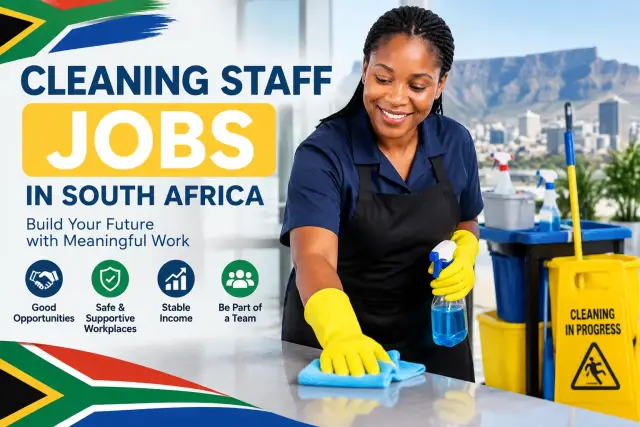
Quick answers about Cleaning Staff Jobs
Q
What is the minimum wage for cleaners in South Africa in 2026?
From 1 March 2026, the national minimum wage is R30.23 per hour worked. A higher minimum may apply under a sectoral determination or bargaining council agreement, so check which rules cover your employer.
Source: Department of Employment and Labour
Q
How much overtime pay should cleaning staff receive?
Qualifying employees must generally be paid at least 1.5 times their normal hourly wage for overtime. Overtime must be agreed to and is generally limited to 10 hours a week; some employees and circumstances are exempt from these working-time rules.
Source: South African Government — Basic Conditions of Employment Act
Q
How much annual leave do cleaners get?
Employees covered by the annual leave provisions are entitled to at least 21 consecutive days of paid annual leave per 12-month leave cycle. For someone working a five-day week, that generally amounts to 15 working days off.
Source: South African Government — Basic Conditions of Employment Act
Q
Do cleaners get paid sick leave?
During each 36-month sick-leave cycle, eligible employees are generally entitled to paid sick leave equal to the number of days they would normally work in six weeks. For a five-day working week, that is 30 days; during the first six months of employment, sick leave accrues at one day for every 26 days worked.
Source: South African Government — Basic Conditions of Employment Act