
Company
CB&I Careers
Location
Houston, TX
Job type
Full-time
Via
CB&I
Apply on
Job description
Company Overview
CB&I® is the world’s leading designer and builder of storage facilities, tanks and terminals. With more than 60,000 structures completed throughout our 135+ year history, we have the global expertise and strategically-located operations to provide customers world-class storage solutions for even the most complex energy infrastructure projects.
Overview
Welds together metal components of products, as specified by layout, blueprints, diagram, work order, welding procedures, or oral instructions, using electric arc-welding equipment.
Responsibilities
- Lays out, fits and welds fabricated heavy plate steel components to assemble tanks and pressure vessel
- Manually guides electrode or gun along weld line, maintaining length of arc and speed of movement to form specified depth of fusion and bead, as judged from color of metal, sound of weld, and size of molten puddle.
- Obtains specified electrode and inserts electrode into portable holder or threads consumable electrode wire through portable welding gun.
- Connects cables from welding unit to obtain amperage, voltage, slope, and pulse, as specified by Welding Engineer.
- Starts power supply to produce electric current.
- Strikes arc which generates heat to make and deposit metal from electrode to work piece and join edges of work piece.
- Welds in flat, horizontal, vertical, or overhead positions.
- Examines weld for bead size and other specifications.
- May manually apply filler rod to supply weld metal.
- May clean or degrease weld joint or work piece, using wire brush, portable grinder, or chemical bath.
- May repair broken or cracked parts and fill holes. May prepare broken parts for welding by grooving or scarfing surfaces.
- May chip off excess weld, slag, and spatter, using hand scraper or power chipper. May preheat work piece, using hand torch or heating furnace.
- May position and clamp work pieces together or assemble them in jig or fixture. May tack assemblies together.
- May cut metal plates or structural shapes.
- May be designated according to type of equipment used as Welder, Carbon Arc (welding); Welder, Flux-Cored Arc (welding); Welder, Gas-Metal Arc (welding); Welder, Gas-Tungsten Arc (welding); Welder, Hand, Submerged Arc (welding); Welder, Plasma Arc (welding); Welder, Shielded-Metal Arc (welding).
- May operate other machine shop equipment to prepare components for welding.
- May be required to pass employer performance tests or standard tests to meet certification standards of governmental agencies or professional and technical associations.
- Responsible for observing and complying with all safety and project rules, including wearing required personal safety equipment. Performs other duties and activities as required.
JOB REQUIREMENTS
- Performing only those jobs on which they have been trained and/or authorized.
- Working in accordance with safe job practices and complying with company safety rules
- Using required personal protective equipment
- Reporting unsafe conditions or practices
- Making safety suggestions
- Serving on the safety committee if requested
- Cooperating during investigation of any accidents that occur
- Taking an active part and participating in safety meetings, pre-job safety briefings, task hazard analyses and Job Safety Analyses.
Local Requirements
Physical Demands:
NP=Not Present, O=Occasionally (0-33%), F=Frequently (34-66%), C=Constantly (67-100%)
- Standing: F
- Walking: F
- Sitting: O
- Crouching: F
- Bending: F
- Balancing: O
- Climbing: O
- Stooping: O
- Crawling: O
- Reaching: F
- Handling: F
- Fingering: F
Lifting (lbs.)
- 0-10 lbs.: F
- 10-20 lbs.: F
- 25-50 lbs.: O
- 50-100 lbs.: NP
- 100+ lbs.: NP
Carrying (lbs.)
- 0-10 lbs.: F
- 10-20 lbs.: F
- 25-50 lbs.: O
- 50-100 lbs.: NP
- 100+ lbs.: NP
Pushing/Pulling (lbs.)
- 0-10 lbs.: O
- 10-20 lbs.: O
- 25-50 lbs.: O
- 50-100 lbs.: NP
- 100+ lbs.: NP
Qualifications
- May require a high school diploma or its equivalent and previous years of related experience.
- Has knowledge of commonly-used concepts, practices, and procedures within a particular field.
- Relies on instructions and pre-established guidelines to perform the functions of the job.
- Works under minimum supervision.
Frequently asked questions
Quick answers about Plumber Jobs
Q
How much do plumbers make in the United States?
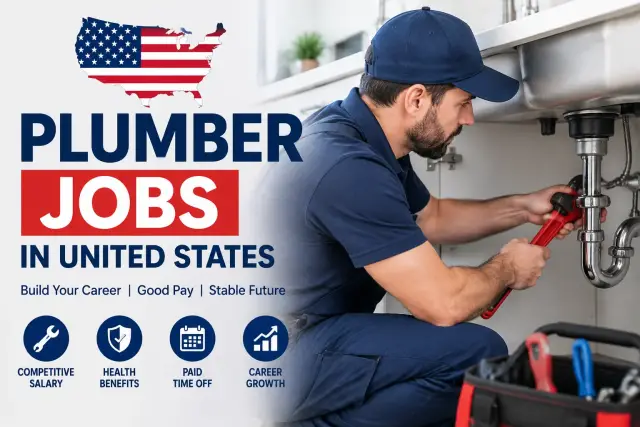
The Bureau of Labor Statistics reported a median annual wage of $62,970 in May 2024 for plumbers, pipefitters, and steamfitters. This is a historical benchmark, not a 2026 wage estimate; earnings vary by location, experience, and employer.
Source: U.S. Bureau of Labor Statistics
Q
How long does it take to become a plumber?
Plumbing apprenticeships typically last 4 or 5 years. Apprentices generally receive about 2,000 hours of paid on-the-job training each year, along with technical instruction.
Source: U.S. Bureau of Labor Statistics
Q
Do I need a license to work as a plumber?
Most states and some localities require plumbers to be licensed. Requirements vary, but many require 2 to 5 years of experience and a licensing exam before a plumber can work independently.
Source: U.S. Bureau of Labor Statistics
Q
What is the minimum pay for a plumbing apprentice in 2026?
The federal minimum wage for covered workers is $7.25 per hour, although a higher state or local minimum may apply. Some employees under age 20 may be paid $4.25 per hour during their first 90 consecutive calendar days of employment. These are legal minimums, not typical plumber wages.
Source: U.S. Department of Labor