

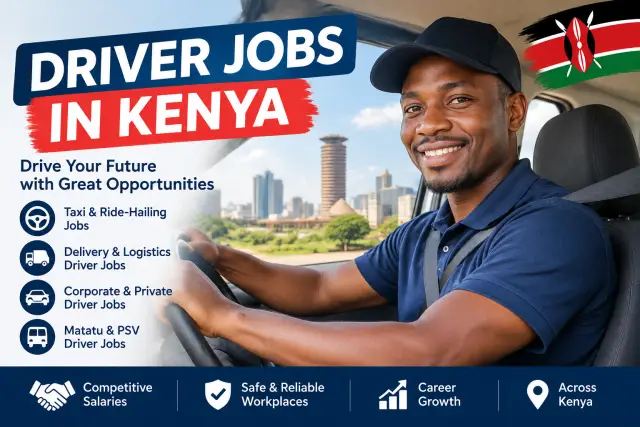
Let me start with something people don't say enough. Driving is one of the few jobs in Kenya where you can start with almost no connections and still earn something decent. You don't need a degree. You need a valid license, a clean record, and the patience to deal with Thika Road at 6pm.
But not all driver jobs are the same. Not even close.
The main types of driver jobs you'll actually find
Here's what I see most often when people go looking.
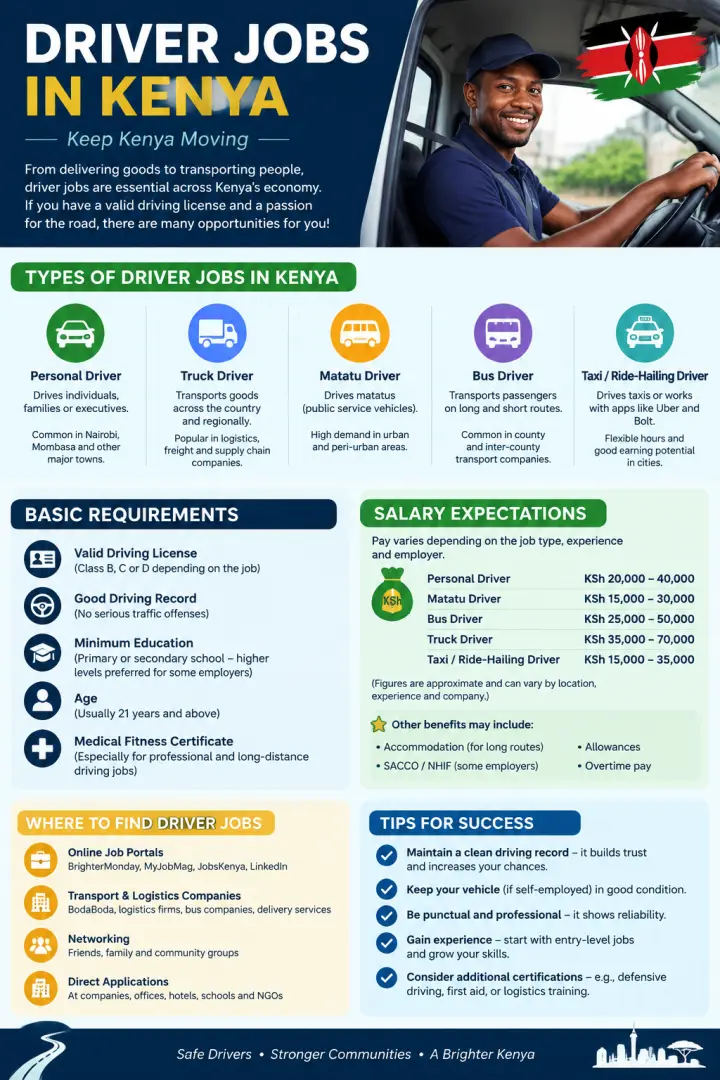
- Personal or family driver. Usually in Nairobi, Mombasa, Kisumu, Nakuru. You drive one household, maybe drop kids at school, run errands, pick the boss up from the airport.
- Company driver. NGOs, hotels, schools, safari firms, supermarkets, construction outfits. Pay is steadier, and there's often a pension or NHIF/NSSF contributions done properly.
- Truck and long-haul driver. Mombasa to Nairobi, Nairobi to Kampala, down to Juba or Kigali. This is where the bigger money sits, and also the longer time away from home.
- PSV driver. Matatus, buses, shuttles. Fast cash, rough hours.
- Ride-hailing and delivery. Uber, Bolt, Little, and delivery apps. You're basically your own boss, for better or worse.
- Tour and safari driver-guides. Think Maasai Mara, Amboseli, Tsavo. Tips can be a big part of the income.
Pick one lane first. Trying to be everything at once usually just gets you nowhere.
Papers you need before anyone will look at you
Honestly, this is where a lot of people get stuck. They've got the skill, but the paperwork isn't in order.
At minimum, you'll need a valid driving license for the class of vehicle you want to drive. Light vehicles, trucks, and buses all fall under different classes, so check with NTSA which one fits. If you're driving a matatu or any passenger-carrying vehicle, you'll also need a PSV badge. No badge, no job. Simple as that.
Then there's the Certificate of Good Conduct from the DCI. Most employers ask for it, especially for private homes and corporate jobs. Get it early because it can take a few days.
Other things that help:
- National ID and KRA PIN
- Copies of your certificates, like a defensive driving course
- First aid training (a big plus for company and tour jobs)
- Two or three referees who'll actually pick up the phone
That last one matters more than you think. Employers call. I've seen good candidates lose offers because the referee never answered.
What do drivers actually earn in Kenya?
Depends. I know that's annoying, but it's true.
From what I've seen and heard, personal drivers in Nairobi often land somewhere around KSh 15,000 to 30,000 a month, sometimes more if you're driving for a senior executive or a diplomat's household. Company drivers can be in a similar range, and a bit higher with allowances. Long-haul truck drivers can go well above that, especially on cross-border routes, once you add trip allowances and overtime. Think KSh 40,000 and up, though it varies a lot by company.
Matatu drivers? Often paid daily or on a target system. Good days are good. Bad days, like when there's a strike or heavy rain, can hurt.
Ride-hailing is its own animal. Gross earnings look nice on screen. Then fuel, commission, service, insurance, and parking take their bite. Do the math on what's left before you decide it's worth it, especially if you're renting the car instead of owning it.
Treat all these numbers as rough guides. Ask the employer directly, and get the offer in writing.
Where to look for jobs
Start online, but don't stop there.
BrighterMonday, MyJobMag, Fuzu, and Corporate Staffing list driver roles regularly. Facebook groups for Nairobi jobs are full of postings too (some good, some sketchy, so read carefully). LinkedIn works better than people expect if you're aiming at corporate or NGO roles.
Now the offline bit. Word of mouth is huge in this industry. Tell the guy you've worked with, your old boss, your cousin who drives for a logistics firm. A lot of transport jobs never get advertised at all. And walk-ins still work with logistics companies around Industrial Area, Mombasa Road, and Athi River. Carry your documents in a neat folder. Looks small, makes a difference.
Beware of the scams
Real talk. This part makes me angry.
If someone asks you to pay a "registration fee" or "processing fee" to get a driver job, walk away. Same for jobs abroad that promise Dubai or Qatar salaries and want money upfront. Some are legit through licensed agencies, but a lot aren't. Check that any recruitment agency is registered with NEA (National Employment Authority) before you hand over a shilling.
Other red flags:
- Interviews only on WhatsApp, with no office address
- Salary that sounds way too good for the role
- Pressure to decide today
- Requests to buy your own uniform or pay for "medical" through M-Pesa
Good employers don't charge you to work for them.
Making your CV not look like everyone else's
Most driver CVs I've seen are a mess. Or they're one page of vague stuff like "hardworking and honest." Everyone says that.
Be specific instead. How many years have you driven? What vehicles? Did you handle a tracker system, logbooks, or fuel records? Did you go five years without an accident? Write that down. If you drove a Prado for a hotel, say so. If you've done Nairobi to Malaba runs, say so.
Keep it to one page, maybe two. Add your license class and expiry date at the top. Employers want to see that fast.
Interview stuff nobody tells you
You'll probably get a driving test. Sometimes it's formal, sometimes the boss just sits in the passenger seat and watches how you handle a roundabout. Stay calm, don't show off. Smooth beats fast every single time.
And they'll ask odd questions. What would you do if you got a flat tyre on Mai Mahiu road at night? What if the boss asks you to speed? What if you're pulled over by a traffic officer? The answers they want are simple: stay safe, follow the law, and be honest.
Dress neat. Be on time. Seems obvious, but trust me, it isn't to everyone.
Level up your chances
Want to stand out from the hundred other applicants? A few things help.
Take a defensive driving course. Learn basic car maintenance, like checking oil, tyre pressure, and fluids, so you can spot a problem before it becomes expensive. Learn to use GPS and Google Maps properly. If you're eyeing tour work, brush up your English and Swahili, and maybe pick up some knowledge about the parks and wildlife. Clients love a driver who can explain what they're looking at.
For truck work, ask about a heavy-vehicle license upgrade and any hazardous cargo training. Fuel tanker drivers, for instance, usually need special certification, and they're paid for it.
The tough side of the job
Not gonna sugarcoat it. Long hours are normal. Traffic wears you down. Some employers delay pay, and some don't register you for NSSF or NHIF (SHIF now) even though they should. Check that your contributions are actually being remitted. You can verify through the official portals.
Long-haul drivers deal with time away from family, border delays, and fatigue. Take rest seriously. A tired driver is a dangerous driver, and no salary is worth a crash.
Still, plenty of people build solid careers here. Some start as a personal driver, save, then buy a second-hand car for ride-hailing. Others move from matatus into company jobs with real benefits. It's a ladder if you treat it like one.
So where do you start tomorrow?
Check your license is valid. Apply for the Good Conduct certificate if you don't have one. Update your CV with real details. Then send out ten applications this week, not two. Message people you know in transport too.
It won't happen overnight, but steady effort pays off. Keep your record clean, keep your word, and the referrals start coming by themselves.