
Company
gpac
Location
Philadelphia, PA
Job type
Full-time
Posted
3 days ago
Via
GPAC Careers - Jobs
Apply on
Job description
Welder/Fitter – Heavy Construction Equipment
Location: South Philadelphia
A well-established heavy civil contractor is currently seeking a certified Welder/Fitter to join its busy Heavy Construction Equipment Mechanic Shop. This is a full-time opportunity for someone who is passionate about welding and fabrication, with a strong attention to detail and a desire to contribute to a high-performing, safety-focused team.
About the Role:
The successful candidate will be responsible for the fabrication and repair of custom prototypes, jigs, fixtures, and structural components for heavy equipment. This includes welding using various techniques, reading technical blueprints, and working closely with other team members to meet production and safety standards.
Compensation & Benefits
- Competitive wages and company bonus program
- Full medical, dental, and vision coverage
- Competitive vacation, holiday, and sick time
- 401(k) savings plans and pension programs
Key Responsibilities:
- Perform MIG, TIG, Stick, and ARC welding on heavy equipment components
- Read and interpret engineering drawings and blueprints
- Fabricate and assemble jigs, fixtures, and production parts
- Operate metal shaping equipment including brakes and shears
- Conduct quality checks to ensure welds meet required specifications
- Perform routine maintenance on equipment and report issues
- Maintain a clean and organized workspace
- Follow all health and safety guidelines
- Document work completed and communicate effectively with team members
Qualifications:
- 3–5 years of welding experience with heavy construction equipment and fabrication
- Valid welding certification (AWS D1.1 Structural Welding - 3G / 4G)
- Drill Rig and pile driving equipment experience a plus
- Strong proficiency in various welding techniques and materials
- Ability to read technical drawings and welding symbols
- High school diploma or equivalent; trade school/apprenticeship a plus
- Valid driver’s license
- Strong safety mindset and physical stamina
Work Conditions:
- Indoor and outdoor work environments
- May be exposed to construction sites
- Occasional travel to off-site locations
- Overtime may be required
- Use of PPE including safety boots and goggles is mandatory
- Ability to lift up to 50 lbs
This is an excellent opportunity to join a company that values family, safety, integrity, and innovation—where teamwork and craftsmanship are at the core of everything they do. If you are a skilled welder/fitter looking to take your career to the next level, we encourage you to apply.
To be considered for this position, you can apply directly.
Frequently asked questions
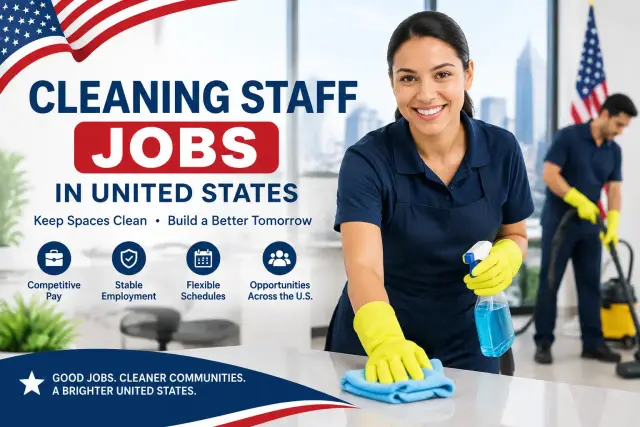
Quick answers about Cleaning Staff Jobs
Q
How much do cleaning staff jobs pay in 2026?
In 2026, the federal minimum wage is $7.25 per hour for covered, nonexempt workers. Many states and localities set higher minimum wages, and eligible workers must receive the higher applicable rate.
Source: U.S. Department of Labor
Q
Do cleaning staff get overtime pay?
Covered, nonexempt employees generally must receive overtime pay for hours worked over 40 in a workweek. The overtime rate is at least 1.5 times their regular rate; for example, a $15 hourly rate generally means at least $22.50 per overtime hour.
Source: U.S. Department of Labor
Q
What safety training should I get before using cleaning chemicals?
Employers must provide information and training on hazardous chemicals when employees are initially assigned to work with them and whenever a new chemical hazard is introduced. Employers must also make safety data sheets readily accessible to workers during each work shift.
Source: Occupational Safety and Health Administration
Q
Can a teenager work a cleaning job?
Federal rules allow 14- and 15-year-olds to perform certain cleanup work, subject to restrictions on duties and hours. They generally may work no more than 3 hours on a school day or 18 hours in a school week; state rules may be more protective.
Source: U.S. Department of Labor