
Company
Scale and Change LLC
Location
Dallas, TX
Job type
Full-time
Salary
28–45 an hour
Posted
4 days ago
Via
via Indeed
Apply on
Job description
We are seeking carbon and/or stainless steel pipe welders for multiple projects that are breaking open in the DFW area. We have plenty of openings and a large backlog of work coming—all long-term jobs of at least 4–6 months in length and a minimum of 40 hours a week. Some jobs will also have 10–30 hours a week in overtime. Some projects that are further outside of the DFW metro area have per diem of up to $120/day worked. For projects more local to the DFW area—we are only seeking locals who can commute daily to the projects, and no per diem will be provided.
Must haves:
- 4–5 years of experience welding on carbon and/or stainless steel pipe (stick/SMAW welders).
- Necessary tools of the trade and PPE.
- Valid identification proving right to work in the US.
- Reliable transportation to get to the job, on time, every day.
To inquire about the projects, please text "DFW WELDER" to any/all of the following:
Pay: $28.00–$45.00 per hour
Benefits:
- Health insurance
- Paid time off
- Referral program
Application Question(s):
- Do you have necessary tools and PPE?
Experience:
- Carbon steel pipe welding: 4 years (Required)
Work Location: In person
Frequently asked questions
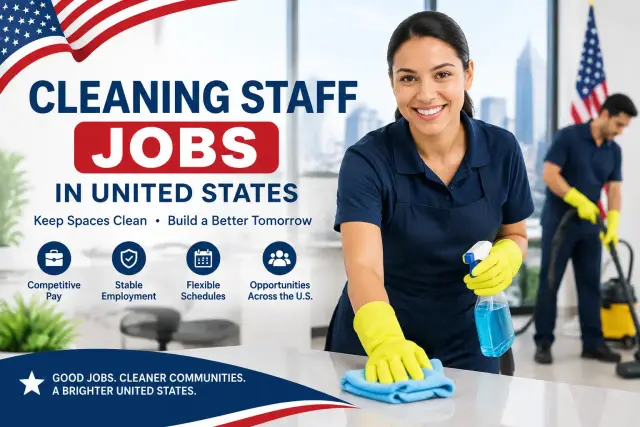
Quick answers about Cleaning Staff Jobs
Q
How much do cleaning staff jobs pay in 2026?
In 2026, the federal minimum wage is $7.25 per hour for covered, nonexempt workers. Many states and localities set higher minimum wages, and eligible workers must receive the higher applicable rate.
Source: U.S. Department of Labor
Q
Do cleaning staff get overtime pay?
Covered, nonexempt employees generally must receive overtime pay for hours worked over 40 in a workweek. The overtime rate is at least 1.5 times their regular rate; for example, a $15 hourly rate generally means at least $22.50 per overtime hour.
Source: U.S. Department of Labor
Q
What safety training should I get before using cleaning chemicals?
Employers must provide information and training on hazardous chemicals when employees are initially assigned to work with them and whenever a new chemical hazard is introduced. Employers must also make safety data sheets readily accessible to workers during each work shift.
Source: Occupational Safety and Health Administration
Q
Can a teenager work a cleaning job?
Federal rules allow 14- and 15-year-olds to perform certain cleanup work, subject to restrictions on duties and hours. They generally may work no more than 3 hours on a school day or 18 hours in a school week; state rules may be more protective.
Source: U.S. Department of Labor