
Company
Company
Location
Los Angeles, CA
Job type
Full-time
Posted
3 days ago
Via
via Jobrapido
Apply on
Job description
Bin Welder 2nd Shift
Locations: City of Industry
Time type: Full time
Posted on: Posted Yesterday
Job requisition ID: JR105698
Summary
The Bin (Mig) Welder reports to the Bin Shop Supervisor. The Bin (Mig) Welder is personally responsible for welding repairs, and fabrication of new and/or replacement parts for solid waste container (dumpster) bodies.
Job Description
- Operate manual and automated welding equipment to repair welds, holes and metal parts on containers and equipment as needed.
- Positions parts using clamps and tack welds.
- Ability to fabricate parts and/or components relative to need or availability.
- Performs safety inspections and checks on containers and equipment.
- Must be able in flat and vertical planes (all position welding), examines for successful welds for depth and penetration (i.e. bead size and other specifications).
- Completes required paperwork associated with repairing containers and equipment; to include documentation of parts usage, and repair times.
- Attendance and successful accomplishment of all safety and compliance training.
Preferred Qualifications
- Bilingual English / Spanish.
- Forklift Operator Certification
- Welder Certification.
Physical/Environmental Demands:
- Physical:
- Seeing, hearing, & smelling continuously.
- Problem solving, standing, oral communication, analytical ability, Handling (holding), organization, concentration, Eye/hand coordination, working with interruptions & interpersonal abilities continuously.
- Sitting, written communication, balancing, bending, crouching, kneeling & walking frequently.
- Pushing, climbing & reaching frequently.
- Lifting up to 75 lbs. frequently.
- Environmental:
- Exposure to dust, smoke, fumes, odors, noise, grease, oil, hot/cold temperatures, standing on concrete & vibration continuously.
- Exposure to electrical hazards, chemicals, and uneven or slippery surfaces frequently.
- Works inside & outside
Salary: $24.44 - $26.00 per hour
Schedule: Monday - Friday, rotating Saturdays from 3:00 pm to 11:30 pm
Benefits:
- Competitive wages
- Comprehensive benefit package Medical, Dental, Vision
- 401K
- Life Insurance
- Paid Vacation and Sick Time
- Career plan
- Recognition programs
- Professional development learning
- An exceptional work environment
Athens will consider for employment qualified applicants with criminal histories in a manner consistent with the requirements of the Los Angeles Fair Chance Initiative for Hiring Ordinance and any other applicable state, federal or local laws. EEO/M/F/disability/veteran
Frequently asked questions
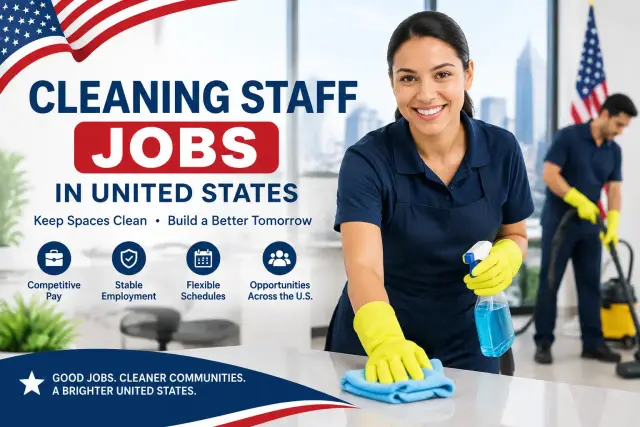
Quick answers about Cleaning Staff Jobs
Q
How much do cleaning staff jobs pay in 2026?
In 2026, the federal minimum wage is $7.25 per hour for covered, nonexempt workers. Many states and localities set higher minimum wages, and eligible workers must receive the higher applicable rate.
Source: U.S. Department of Labor
Q
Do cleaning staff get overtime pay?
Covered, nonexempt employees generally must receive overtime pay for hours worked over 40 in a workweek. The overtime rate is at least 1.5 times their regular rate; for example, a $15 hourly rate generally means at least $22.50 per overtime hour.
Source: U.S. Department of Labor
Q
What safety training should I get before using cleaning chemicals?
Employers must provide information and training on hazardous chemicals when employees are initially assigned to work with them and whenever a new chemical hazard is introduced. Employers must also make safety data sheets readily accessible to workers during each work shift.
Source: Occupational Safety and Health Administration
Q
Can a teenager work a cleaning job?
Federal rules allow 14- and 15-year-olds to perform certain cleanup work, subject to restrictions on duties and hours. They generally may work no more than 3 hours on a school day or 18 hours in a school week; state rules may be more protective.
Source: U.S. Department of Labor