
Company
LETSCORPORATE ENTERPRISE PRIVATE LIMITED
Location
Singapore
Posted
6 days ago
Via
via Trabajo.org
Apply on
Job description
Key Responsibilities:
- Install, inspect, service, and repair refrigeration and air conditioning systems.
- Diagnose mechanical and electrical faults in HVAC/R systems.
- Perform routine maintenance on commercial and residential cooling systems.
- Recharge systems with refrigerant and check for leaks.
- Read and interpret technical drawings, schematics, and manuals.
- Calibrate thermostats and ensure systems operate efficiently.
- Maintain records of repairs, maintenance schedules, and compliance checks.
- Comply with health and safety standards and regulations.
- Recommend system upgrades or replacements when needed.
- Work independently or as part of a team in various settings (residential, commercial, or industrial).
Requirements:
- Diploma or Certificate in Refrigeration and Air Conditioning Engineering or equivalent.
- Proven experience as an HVAC/R technician or engineer.
- Knowledge of refrigeration cycles, electrical systems, and control systems.
- EPA or equivalent certification for handling refrigerants (if applicable).
- Strong problem-solving skills and attention to detail.
- Ability to work in confined spaces or at heights, as required.
- Valid driver’s license (if fieldwork is involved).
- Good communication and customer service skills.
Preferred Qualifications:
- Experience with energy-efficient and smart ACMV and HVAC systems.
- Familiarity with Building Management Systems (BMS).
- Knowledge of local HVAC codes and safety regulations.
- Welding and brazing skills.
Working Conditions:
- Work may involve travel to client sites or facilities.
- May require overtime, weekend, or on-call shifts.
- Work in varying environments, including hot or cold temperatures.
Technical Skills
HVAC System Installation & Repair
- Installing air conditioning, refrigeration, and ventilation systems.
- Diagnosing faults and carrying out repairs.
Refrigeration Cycle Knowledge
- Understanding the thermodynamic cycle (evaporation, compression, condensation, expansion).
Electrical & Electronic Skills
- Wiring systems, reading circuit diagrams.
- Knowledge of control systems and sensors.
Mechanical Aptitude
- Understanding of compressors, condensers, evaporators, and fans.
- Ability to use tools and machinery safely.
System Design & Sizing
- Load calculations for appropriate system selection.
- Ductwork and piping design.
Refrigerant Handling
- Safe handling of refrigerants (e.g., R-410A, R-134a).
- Knowledge of recovery, recycling, and leak detection procedures.
- EPA 608 certification (or equivalent depending on country).
Energy Efficiency & Environmental Compliance
- Knowledge of green technologies (like inverter systems, VRF/VRV systems).
- Awareness of climate regulations and refrigerant phase-outs (e.g., F-Gas regulations).
Computer & Software Proficiency
- Using diagnostic tools and software (e.g., BMS systems, HVAC design tools like AutoCAD, Revit MEP).
Practical Skills:
Blueprint Reading
- Interpreting technical drawings and schematics.
Welding & Brazing
- Joining refrigerant piping and components.
Preventive Maintenance
- Scheduling and executing regular maintenance.
- Keeping detailed service records.
Testing & Calibration
- Using gauges, multimeters, leak detectors, and pressure sensors
Frequently asked questions
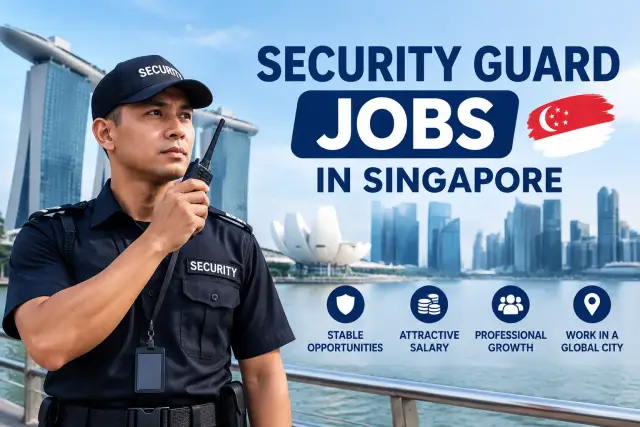
Quick answers about Security Guard Jobs
Q
How much overtime pay should a security guard receive in Singapore?
If you are covered by the Employment Act’s overtime provisions, overtime must generally be paid at least 1.5 times your hourly basic rate. For a non-workman, the overtime provisions generally apply if your monthly basic salary is $2,600 or less; check your employment terms and whether any exemptions apply.
Source: Ministry of Manpower
Q
How many hours can a security guard be asked to work?
The general contractual limit under the Employment Act is 44 hours a week for employees covered by its working-hours provisions. Overtime is generally capped at 72 hours a month, although approved exemptions may apply.
Source: Ministry of Manpower
Q
When should a security company pay my salary and overtime?
Your employer must generally pay your salary within 7 days after the end of the salary period. Overtime pay must be paid within 14 days after the end of that period.
Source: Ministry of Manpower
Q
How much annual leave do security guards get?
If you are covered by the Employment Act and have worked for your employer for at least 3 months, you are entitled to paid annual leave. The statutory minimum starts at 7 days for the first year of service and rises to 14 days from the eighth year.
Source: Ministry of Manpower