
Company
NXP Semiconductors
Location
Kuala Lumpur, Federal Territory of Kuala Lumpur
Job type
Full-time
Posted
23 hours ago
Via
via LinkedIn
Apply on
Job description
The Senior Flip-Chip Front-End Packaging Development Engineer – Die Attach & Underfill is responsible for leading FC-FE process development, optimization, and integration activities for die attach and underfill process. This role requires strong technical capability in process characterization, DOE, troubleshooting, yield improvement, material qualification, and equipment readiness to support packages development and production release. The engineer will work closely with cross-functional teams to ensure robust process performance, manufacturability, reliability, and continuous improvement across flip-chip packaging platforms.
Process Ownership & Optimization
- Take ownership of FC-FE die attach and underfill processes for semiconductor packages, including advanced package platforms.
- Define, develop, optimize, and maintain critical process parameters for die placement, bonding, reflow, underfill dispensing, cure, CSAM, and related process controls.
- Lead design of experiments (DOE) activities to improve process yield, product reliability, void control, fillet quality, underfill flow, curing profile, and CSAM performance.
- Diagnose and resolve complex front-end process defects through systematic analysis and data-driven decision-making.
Advanced Troubleshooting & Yield Improvement
- Drive root cause analysis for yield excursions using structured problem-solving methodologies, including 8D, Fishbone, 5-Why, and FTA.
- Develop and implement corrective and preventive actions to sustain yield improvement and prevent recurrence.
- Monitor yield performance and initiate continuous improvement projects to enhance process capability.
- Analyze inline process data and reliability results to identify potential process risks and improvement opportunities.
Tooling & Equipment Management
- Lead tooling, fixture, and dispense process improvements in collaboration with vendors to support first-time NPI-development requirements.
- Support die attach and underfill, CSAM equipment qualification, calibration, upgrades, and readiness for production deployment.
New Product Leadership
- Lead process development activities for new packages from concept phase through production release.
- Conduct technology research, process characterization, and process window development to support NPI readiness.
- Collaborate with the design engineering team to define and validate Design for Manufacturability (DFM) requirements.
- Prepare and maintain process documentation, including specifications, work instructions, control plans, and related technical records.
Material & Process Integration
- Evaluate and qualify FC-FE-related materials, including die attach materials, flux, underfill, and associated consumables to support process performance, manufacturability, and reliability requirements.
- Work closely with suppliers to address material-related issues, drive improvements, and support qualification activities.
- Assess interactions among die attach process design, underfill material properties, curing conditions, CSAM results, package structure, and reliability performance to ensure robust process integration.
- Establish underfill inspection and acceptance criteria, including CSAM verification for voids, delamination, non-wet, flow coverage, and cure-related defects.
- Experience or familiarity with AI-based simulation tools will be considered an advantage.
Cross-Functional & Leadership Role
- Serve as the technical lead across operations, quality, product engineering, suppliers, and subcontractors to ensure process alignment and performance.
- Mentor junior engineers and technicians in process development, equipment troubleshooting, and structured problem-solving.
- Provide proactive technical support for failure analysis reviews, risk assessments, and cross-functional technical discussions.
Qualifications
Education
- Bachelor’s degree in Mechanical Engineering, Materials Science, Chemical Engineering, or a related discipline.
Experience
- Minimum of five years of experience in semiconductor packaging, with strong exposure to FC-FE die attach, and underfill dispensing processes. Familiarity with the end-to-end flip-chip process flow will be considered an advantage.
- Demonstrated hands-on experience in high-volume manufacturing and fast-paced development environments.
More information about NXP in Malaysia...
Frequently asked questions
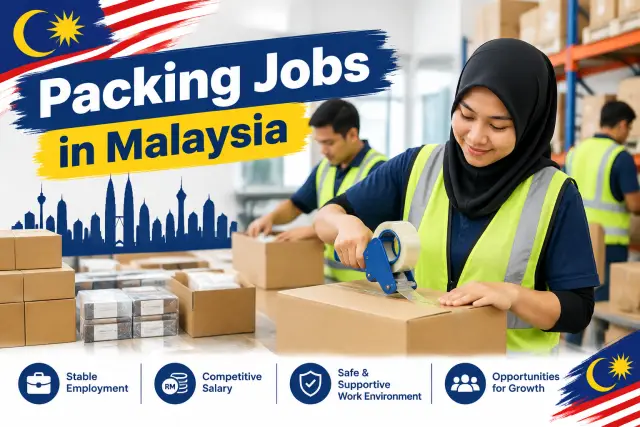
Quick answers about Packing Jobs
Q
What is the minimum wage for packing jobs in Malaysia in 2026?
Under the Minimum Wages Order 2024, which took effect on 1 February 2025, the minimum wage for packing workers is RM1,700 per month, or RM8.17 per hour. It covers both Malaysian and foreign workers. It applies to employers with 5 or more employees, and since 1 August 2025 to smaller employers as well. A packer paid below RM1,700 for a full month is being underpaid and can file a complaint with the Labour Department.
Source: Ministry of Human Resources Malaysia (KESUMA)
Q
How many hours can a packing operator work per week and how much is overtime pay?
Under the Employment Act 1955, the maximum normal working time is 45 hours per week, and total overtime is capped at 104 hours per month. Overtime is paid at 1.5 times the hourly rate on normal working days, 2 times on rest days and 3 times on public holidays. For a worker on RM1,700 per month (RM8.17 per hour), weekday overtime is about RM12.26 per hour and public holiday overtime is about RM24.51 per hour.
Source: Jabatan Tenaga Kerja Semenanjung Malaysia (JTKSM)
Q
How many days of annual leave and sick leave do packing workers get under the Employment Act?
Employees covered by the Employment Act 1955 get 8 days of paid annual leave in the first 2 years, 12 days for 2 to 5 years and 16 days after 5 years. Paid sick leave is 14, 18 or 22 days per year by the same length-of-service bands, plus up to 60 days if hospitalised. Employees also get at least 11 paid public holidays a year, and maternity leave is 98 days.
Source: Jabatan Tenaga Kerja Semenanjung Malaysia (JTKSM)
Q
Do I need any certificate or medical check to work in a food packing factory?
Most general packing jobs need no formal qualification, but food packing workers must attend a Food Handler Training Course recognised by the Ministry of Health under the Food Hygiene Regulations 2009. They must also have a typhoid vaccination, which is valid for 3 years. Employers can ask for these before confirming your start date, and they usually arrange the training.
Source: Ministry of Health Malaysia (KKM)