


Packing jobs don't get much glamour. Nobody brags about them at family dinners. But if you've ever needed income quickly in Malaysia, with no degree, no fancy résumé, and maybe not much experience, you've probably looked at one.
So let's talk about what these jobs are really like. Not the polished version from a job ad.
What does a packer actually do all day?
Depends on where you land. That's the honest answer.
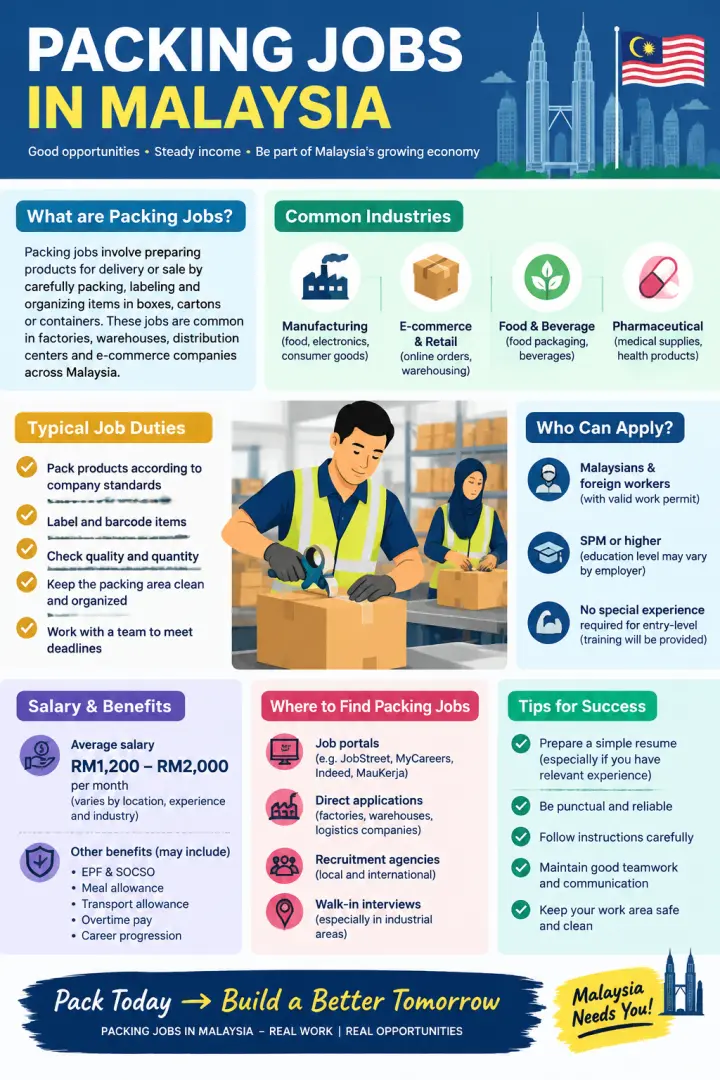
In a factory, you might be putting snacks into boxes, sealing bags, sticking labels, or checking that nothing's damaged before it goes on a pallet. In an e-commerce warehouse (think the ones around Shah Alam, Klang and Puchong), you pick an order, wrap it, box it, tape it and pass it on. Over and over. Hundreds of times a shift.
Electronics factories in Penang are a different thing again. Cleaner, quieter, sometimes with special gear like gloves or antistatic wear. Food factories can be cold. Really cold, if you're near frozen goods.
Common tasks you'll see listed:
- Sorting and counting items
- Folding boxes and sealing them
- Labelling and scanning barcodes
- Basic quality checks (spotting dents, leaks, wrong items)
- Stacking cartons, sometimes onto pallets
Nothing too complicated. The hard part isn't the thinking. It's standing for hours and keeping a steady pace.
How much can you earn?
Let's get to the money, since that's why most people are reading this.
The minimum wage in Malaysia is RM1,700 a month for most employers now, which works out to roughly RM8.17 an hour. Packing jobs usually start around that number, sometimes a bit higher in the Klang Valley or Johor where companies compete for workers. Check the latest rules though, because wage rules shift and smaller employers had a slightly different timeline.
Basic pay isn't the full picture. Overtime is where a lot of packers make their real money. Under the Employment Act, overtime on a normal working day is paid at 1.5 times your hourly rate. Rest days and public holidays pay more. During busy seasons like Hari Raya, 11.11 or 12.12 sales, some people clock a lot of extra hours.
From what I've seen, a packer who takes steady overtime can end up well above RM2,000 a month. But that's tiring money. Be honest with yourself about how many 10-hour days you can stomach.
Other stuff on the payslip
Check for these before you say yes:
- EPF contribution (your employer should be putting in too)
- SOCSO coverage
- Attendance bonus, which some places give if you don't skip a single day
- Meal or transport allowance
- Shift allowance for night work
Ask about all of it. Don't be shy. A job paying RM1,800 with allowances can beat one paying RM2,000 with nothing else.
Where to find real openings
Start with the usual job sites. JobStreet, Maukerja and Hiredly all list warehouse and packing roles daily. The government's MYFutureJobs portal is worth a look too, and honestly a lot of people forget about it.
Facebook groups are huge for this. Search for "kerja kosong" plus your area, like Kerja Kosong Shah Alam or Kerja Kosong Johor Bahru, and you'll find posts from factories and agents. Quality varies. Some are legit, some are... not.
And then there's the old-school way. Walk past an industrial area and look at the signboards outside factory gates. Seriously. Plenty of factories hang a "Dicari: Operator Pengeluaran" banner and never bother posting online. Note that the job title isn't always "packer." You'll see "production operator," "general worker," or "packing operator." Search all of them.
Scams. Let's not skip this part.
Here's the thing. Anytime someone asks you to pay money upfront for a packing job, walk away. Registration fee, "training fee," deposit for uniforms. Doesn't matter how friendly they sound on WhatsApp.
Home-based packing offers are the worst for this. You know the ones: "Pack products at home, earn RM3,000 a month!" Usually you pay for a starter kit and then the company vanishes, or says your work isn't up to standard. Not great.
A few red flags I'd watch:
- Pay that sounds way too high for simple work
- No company name, no address, no SSM registration you can check
- Pressure to decide today
- Interview done only through chat, with no actual workplace visit
You can look up a company on the SSM website in a couple of minutes. Do it.
What about foreign workers?
Lots of packing roles in Malaysia are filled by migrant workers, but the process is strict. You can't just show up and start. An employer needs approval to hire you, and the permit is tied to that employer and that sector. Working outside that, or without a valid permit, can mean serious trouble for both you and the company.
If you're abroad and thinking of coming over, go through licensed channels only. Check that any agent is properly approved. And don't hand over your passport to anybody who isn't your employer or an official body. Paying huge recruitment fees to agents is a trap many workers fall into, so ask questions and keep records.
Already in Malaysia on a valid permit? Talk to your employer or the relevant authority about what you're allowed to do before switching anything.
Shifts, hours and what it feels like
Standard working hours are capped at 45 per week under the law. Most factories run an 8-hour day, six days a week, or maybe five if you're lucky. Some warehouses run two or three shifts, which means night work is on the table.
Night shifts usually pay a bit more. They also mess with your body clock, and I'd say they're not for everyone. Try them for a month before you decide.
The first week is the toughest. Your feet hurt. Your back hurts. You feel slow compared to the aunties who've been packing for ten years and can seal a box without looking. Give it time. By week three, most people find a rhythm.
Tips that actually help
Wear proper shoes. Not slippers, not cheap canvas ones. Spend a bit on something with cushioning, because you'll be on concrete all day.
Ask about transport before accepting. A job that's 40 minutes away by bus might look fine on paper, then eat up your wage in fares and time. Some factories offer shuttle buses or hostels, and that can swing the whole decision.
Get your offer in writing. Salary, hours, overtime rate, probation period. A WhatsApp message counts better than a verbal promise (screenshot it).
And be careful with agency contracts. Some packing jobs come through a manpower agency instead of directly from the factory. That's not automatically bad, but you may get fewer benefits or a shorter contract. Ask who your actual employer is.
Can it lead anywhere?
It can. Not always, but it can.
People who show up on time, stay careful and learn the system often move up to line leader, QC checker, forklift operator or inventory clerk. Those roles pay more and the work is usually easier on your body. Supervisors notice who's reliable. It sounds simple because it is.
If you want to move up faster, pick up small skills. Learn how the scanning system works, get a forklift licence if the company supports it, or improve your basic English and Bahasa Malaysia for reading instructions and labels. Little things, but they add up.
Is packing a forever job? For most people, no. Is it a decent starting point when you need steady pay and a fixed routine? Yeah, I think so. Just go in with your eyes open, check the details, and don't pay anyone for a job.