

Welder Jobs in Qatar: A Practical Guide for Job Seekers
Qatar offers welding work across construction, manufacturing, maintenance, ship repair, and the oil and gas industry. Employers hire welders for everything from structural steel and workshop fabrication to high-pressure piping and shutdown projects.
If you're searching for welder jobs in Qatar, your welding process, test results, and practical experience often matter as much as your job title. A general fabricator and a certified pipe welder, for example, may see very different job offers.
Here's what to know about common roles, pay, qualifications, applications, and working conditions before you accept a position.
What Do Welders Do in Qatar?
Welders join, repair, and shape metal components using heat and welding equipment. The exact work depends on the project. You might weld steel frames in a fabrication yard, repair equipment in a workshop, or work on pipes at an industrial site.
Typical duties include:
- Reading drawings, welding symbols, and work instructions.
- Preparing and cleaning metal surfaces before welding.
- Setting up welding machines and choosing the right consumables.
- Welding joints in the required positions and checking the finished work.
- Following safety procedures for fumes, heat, confined spaces, and fire risks.
- Working with fitters, fabricators, inspectors, and supervisors.
Some jobs also involve grinding, cutting, measuring, and basic fabrication. Read the vacancy carefully: a welder-fabricator role usually asks for broader workshop skills than a welding-only position.
Types of Welder Jobs in Qatar
Structural welder
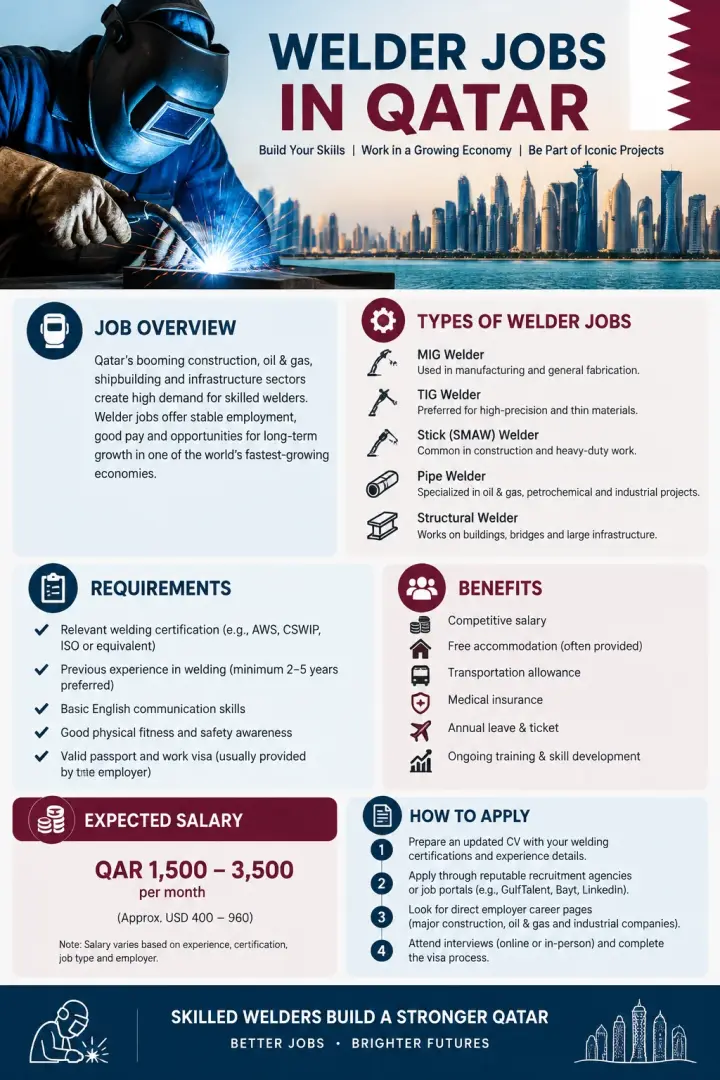
Structural welders work on beams, columns, platforms, supports, and other steel structures. These jobs are common on construction projects and in fabrication shops. Employers may ask for experience with SMAW, FCAW, or other processes, along with the ability to read structural drawings.
Pipe welder
Pipe welders join and repair piping used in industrial facilities, utilities, and energy projects. The work can require careful preparation and welding in difficult positions. Depending on the job, employers may request a pipe welding test, experience with specific materials, or qualifications tied to a recognized code.
TIG welder
TIG welding, also known as GTAW, is used when a controlled, clean weld is important. TIG welders may work with stainless steel, carbon steel, aluminum, or other metals. Some vacancies combine TIG root-pass experience with another process for filling and finishing the joint.
MIG and flux-cored welder
MIG welding is also called GMAW. Flux-cored arc welding is known as FCAW. Both appear in workshop and fabrication vacancies, although the materials, shielding methods, and equipment can differ. Make sure your CV names the process you've actually used rather than listing them as interchangeable skills.
6G welder
A 6G welder vacancy usually refers to a pipe-welding test position in which the pipe is fixed at an angle. Employers often use the term when looking for welders comfortable working around a joint in several positions. A 6G test is not a single universal certificate for every job: the accepted qualification still depends on the code, process, material, and employer's requirements.
Maintenance and shutdown welder
Maintenance welders repair equipment and metalwork in existing facilities. Shutdown roles are often tied to a planned maintenance period and can be short-term. Before accepting one, ask about the contract length, work schedule, overtime, and what happens when the shutdown ends.
Where to Find Welding Jobs in Qatar
Start with employers and recruiters that advertise the kind of welding you do. Useful places to look include:
- Company career pages for contractors, fabrication businesses, shipyards, and industrial service providers.
- Established job websites with Qatar listings, including LinkedIn, Indeed, Bayt, and GulfTalent.
- Licensed recruitment agencies in your home country or Qatar.
- Professional contacts, former coworkers, and trade groups that share verified vacancies.
Try more specific searches than just “welder jobs.” Phrases such as “TIG welder jobs in Qatar,” “6G pipe welder Qatar,” or “structural welder Doha” can bring up roles closer to your skills. Also search for “welder fabricator” if you can fit and assemble parts as well as weld.
Check when a listing was posted and whether it names the actual employer. If an advertisement is vague, ask for the company name, work location, job description, and full package before sending sensitive documents.
Welder Salary in Qatar
Welder pay in Qatar varies considerably. A workshop role, a specialist pipe-welding job, and a short shutdown contract may have different basic salaries and benefits. Your process, test results, years of experience, project, and employer all affect the offer.
Some advertised general welding jobs fall around QAR 1,500 to QAR 3,500 per month, while experienced or specialist roles may offer more. These are rough examples, not verified current market rates or guaranteed salaries. Overtime and benefits can also make a big difference, so compare actual offers rather than relying on a headline figure.
Ask for these details in writing:
- Monthly basic salary and payment date.
- Working hours, weekly rest day, and overtime rate.
- Whether accommodation and meals are provided or paid as allowances.
- Transport to and from the worksite.
- Medical coverage, annual leave, and return-ticket arrangements.
- Any deductions and the reason for each one.
Qatar's minimum wage is QAR 1,000 per month in basic pay. Employers must also provide suitable food and accommodation or pay minimum allowances of QAR 300 for food and QAR 500 for accommodation. That's a legal minimum, not a recommended salary for a skilled welder. Check current requirements with Qatar's Ministry of Labour when reviewing an offer.
Honestly, a higher salary doesn't always mean a better package. If one employer provides housing and transport and another doesn't, your take-home costs may be very different.
Qualifications and Skills Employers Look For
Not every welding vacancy requires the same certificates. Entry-level workshop positions may focus on practical ability, while industrial and pipe-welding jobs can have stricter qualification requirements.
Depending on the role, employers may look for:
- Hands-on experience with SMAW, GTAW, GMAW, FCAW, or another specified process.
- Experience welding the materials and joint types used on the project.
- The ability to read fabrication drawings and follow a welding procedure specification.
- A successful practical welding test.
- Welder qualifications relevant to standards such as ASME Section IX, AWS D1.1, or ISO 9606-1, when specified.
- Knowledge of workshop safety, protective equipment, and permit-to-work procedures.
- Basic communication skills in English or the language used on site.
Certification requirements are project-specific. An old certificate, or one covering a different process or material, may not meet the employer's needs. Don't claim a qualification you can't document, and be prepared to take a new test even if you've welded for years.
How to Apply for a Welder Job in Qatar
1. Put your practical skills near the top of your CV
Include your job title, years of experience, welding processes, materials, and the types of projects you've worked on. Mention pipe sizes, thicknesses, positions, or codes only when you can support those details. If you've worked as a fitter-welder, say what fitting and fabrication tasks you handled.
2. Gather your documents
Employers may ask for a passport copy, work history, training records, welding certificates, and references. Requirements vary by employer and visa process. Keep clear copies ready, but share personal documents only after you've checked who is requesting them and why.
3. Prepare for a trade test
A practical test may assess weld appearance, dimensions, technique, and adherence to a procedure. Depending on the job, the test piece may also be examined using non-destructive or other testing methods. Ask which process, material, position, and code will be used so you can prepare appropriately.
4. Review the offer before agreeing
Get the salary, benefits, job title, work location, and contract terms in writing. If something discussed in an interview is missing from the offer, ask for clarification. Keep copies of the offer and signed contract.
5. Confirm the legal work process
Foreign workers generally need the appropriate employer-sponsored work authorization and residence arrangements. The process and required medical or document checks can vary. Check current guidance from Qatar's Ministry of Interior and Ministry of Labour, and use the Qatar Visa Center where applicable to your nationality. Don't assume a visit visa gives you permission to work.
Working Conditions and Safety
Welding can be physically demanding, particularly on outdoor projects or in industrial facilities. You may work at height, in hot weather, or in restricted spaces. Shift patterns and overtime depend on the employer and project.
Before joining, ask who supplies protective equipment and what safety training is provided. A safe setup should address welding fumes, eye protection, fire prevention, electrical hazards, and ventilation. Confined-space work needs specific controls and authorization; it isn't just a matter of putting on a mask.
Qatar also has rules intended to protect workers from summer heat. Ask how the employer manages outdoor work, rest, drinking water, and heat stress, and check current Ministry of Labour guidance for applicable restrictions.
How to Spot a Job Scam
Genuine employers should be willing to explain the role and provide a written offer. Be cautious if someone promises an immediate visa and a very high salary without checking your skills, or pressures you to send money quickly.
- Verify the company through its official website and contact details, not just the number in a message.
- Be wary of recruiters using personal accounts while claiming to represent a major company.
- Don't pay an employer or recruiter for a job offer or work visa. Qatar prohibits charging recruited workers recruitment fees; check the applicable rules and report suspicious demands.
- Never sign a contract you don't understand or accept unexplained changes after arrival.
- Keep copies of messages, receipts, your offer, and your contract.
If you're already in Qatar and have an employment concern, contact the Ministry of Labour through its official channels. Workers may change employers under Qatar's labor rules without a no-objection certificate, but notice and other requirements can apply. Check the current process before taking action.
Frequently Asked Questions
Do I need a degree to work as a welder in Qatar?
Usually, a university degree isn't the main requirement. Employers are more likely to focus on trade training, practical experience, relevant qualifications, and your welding test. Each vacancy has its own criteria.
Can a fresher get a welder job in Qatar?
It's possible, especially for assistant, trainee, or junior workshop roles, but many overseas vacancies ask for experience. If you're starting out, document your training and practice, and look for positions that clearly welcome entry-level candidates.
Is accommodation included in welder jobs?
Some employers provide shared accommodation; others offer an allowance. Don't assume it's included. Ask what the housing is like, whether utilities are covered, and how far it is from the worksite.
Which welding skills are useful for Qatar jobs?
Skills in TIG, stick, MIG, and flux-cored welding can all be useful, depending on the vacancy. Pipe welding, drawing reading, fabrication, and experience with specified codes may help you qualify for more specialized roles.
How long does recruitment take?
There isn't one reliable timeline. Trade tests, document checks, employer approvals, and visa procedures can all affect the schedule. Ask the recruiter for an estimated timeline, but wait for official confirmation before making expensive travel or resignation decisions.
Getting Ready for Your Search
A strong application starts with an honest CV and a clear idea of the work you can do. Search for roles that match your process and experience, prepare for a practical test, and compare the full employment package—not just the salary.
Most importantly, verify the employer and read the contract before committing. A little checking upfront can save you a lot of trouble later.