

Welder Jobs in the Philippines: Skills, Pay, and How to Apply
Welder jobs are found across the Philippines, from small fabrication shops to construction sites, shipyards, and manufacturing plants. If you like practical work and don't mind getting your hands dirty, welding can be a solid career path. It takes training, patience, and a serious approach to safety, but you don't necessarily need a college degree to get started.
Whether you're looking for your first welding job or hoping to move into a better-paying specialty, this guide covers the skills employers look for, where to find openings, and what to check before accepting an offer.
What Does a Welder Do?
A welder joins or repairs metal parts using heat, tools, and different welding processes. The job can involve building steel frames, repairing equipment, making gates and railings, or working on pipes and ship components.
Day-to-day tasks depend on the employer, but often include:
- Reading drawings, measurements, and work instructions
- Preparing and positioning metal parts before welding
- Setting up welding machines and checking equipment
- Joining, cutting, or repairing metal components
- Inspecting welds for defects and making repairs
- Following workplace safety and fire-prevention procedures
Some welders work indoors at a fixed workstation. Others travel to construction sites or work outdoors in hot, noisy conditions. Before applying, check whether the role involves night shifts, site work, travel, or physically demanding positions.
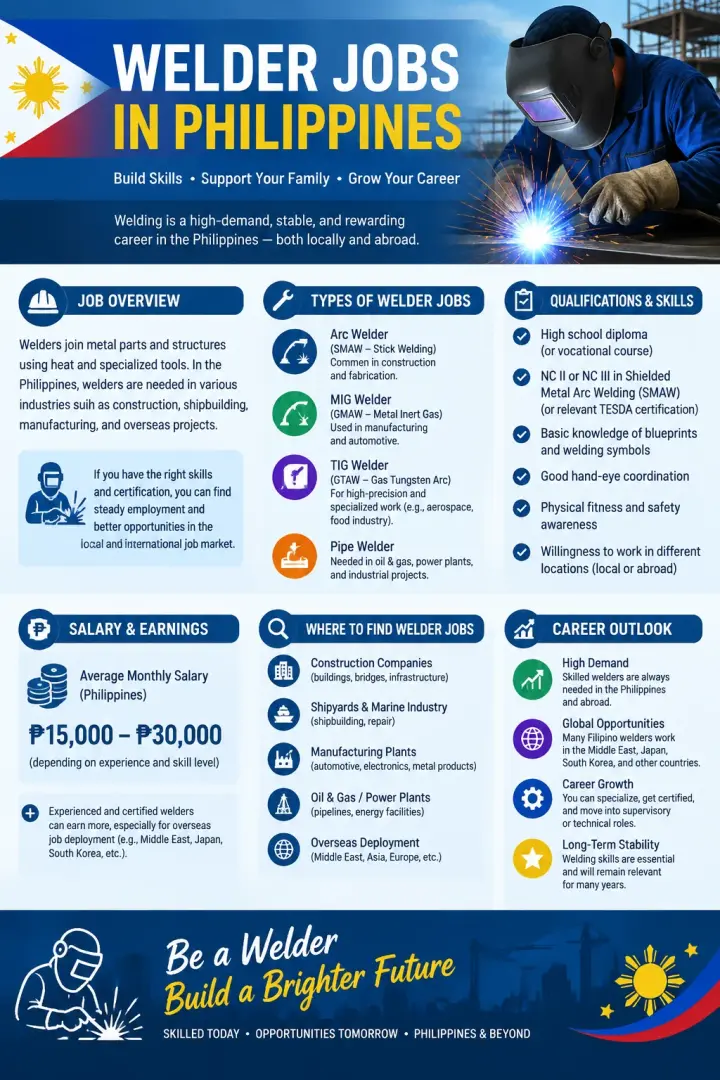
Types of Welder Jobs in the Philippines
Job titles can be confusing because employers don't always use them consistently. Focus on the process, materials, and experience listed in the posting rather than the title alone.
Shielded Metal Arc Welder
Shielded Metal Arc Welding, or SMAW, is commonly called stick welding. It's used in construction, repair, and fabrication. SMAW can be a practical starting point for people entering the trade, particularly those taking a TESDA training course.
MIG or GMAW Welder
Metal Inert Gas welding is commonly referred to as MIG, while the broader process is called Gas Metal Arc Welding, or GMAW. These roles are often found in fabrication and manufacturing. Employers may look for experience with particular materials, thicknesses, and production equipment.
TIG or GTAW Welder
Tungsten Inert Gas welding, also known as Gas Tungsten Arc Welding or GTAW, requires careful control and is often used when a clean, precise weld is needed. Some jobs involve stainless steel, aluminum, or piping. Training and practice matter because the work can be more demanding than it first looks.
Pipe Welder
Pipe welders join and repair piping used in industrial facilities and other projects. Employers may require specific welding positions, procedures, or test results. A company welding test is common, and having a general welding certificate doesn't automatically qualify you for every pipe welding role.
Fabricator-Welder
A fabricator-welder does more than make welds. The role may also involve measuring, cutting, fitting, and assembling metal parts. If you enjoy working from drawings and seeing a project come together, this can be a good fit.
Where Can Welders Work?
Welding skills are needed in several industries, although openings change with local projects and business demand. You can look for work with:
- Construction and steel structure contractors
- Shipbuilding and ship repair companies
- Manufacturing plants and metal fabrication shops
- Automotive and heavy equipment repair businesses
- Industrial maintenance contractors
- Engineering firms working on piping and plant equipment
- Small businesses making gates, railings, furniture, and other metal products
Industrial areas and cities may have more listings, but smaller shops also hire welders in provincial communities. Local Public Employment Service Offices, or PESOs, can be useful when you're looking for opportunities close to home.
Welder Salary in the Philippines
Welder pay varies widely by location, employer, skill level, and type of work. As a rough starting point, some local job listings advertise around ₱15,000 to ₱25,000 per month for welder roles. Experienced welders or those with specialized skills may find higher offers, while some positions pay less or use daily rates. These figures are only a guide, not a guaranteed salary or a current market average.
When comparing offers, look beyond the headline amount. Ask about:
- Whether the rate is monthly or daily and how many days you're expected to work
- Overtime, holiday, rest-day, and night-shift pay where applicable
- Project duration, probation, and employment status
- Transportation, meals, accommodation, or site allowances
- SSS, PhilHealth, and Pag-IBIG contributions and other applicable benefits
- Who provides protective equipment and covers required training or testing
Minimum wage rates vary by region and may depend on the applicable wage order and circumstances. Check the relevant Regional Tripartite Wages and Productivity Board information if you're unsure whether an offer meets the rules for your area.
Qualifications for Welder Jobs
Requirements differ from one employer to another. Some hire beginners and provide training, while others need welders who can pass a trade test and work with little supervision. Common requirements include:
- Practical welding skills for the process named in the job posting
- Ability to read basic measurements and, for some roles, technical drawings
- Knowledge of equipment setup, inspection, and safe work practices
- A TESDA National Certificate or other relevant training, when required
- Experience with the specified material, welding position, or industry
- Ability to meet the physical demands of the job safely
Some employers also ask for a medical exam, background documents, or a practical test. Don't be discouraged if you don't meet every preferred qualification, but be honest about the processes and materials you can actually work with.
TESDA Welding Courses and Certification
TESDA-accredited training can be a useful way to build welding skills, especially if you're starting from scratch. Shielded Metal Arc Welding NC I and NC II are among the qualifications you may encounter when searching for training. Other welding qualifications and programs may also be available, depending on the training center.
Training and certification aren't quite the same thing. Completing a course can prepare you for assessment, but earning a National Certificate generally requires passing the relevant competency assessment. Employers may still ask you to take their own practical welding test.
Before enrolling, check the program and training provider through TESDA's official channels. Ask about:
- The exact qualification and welding process covered
- Course schedule, hands-on training hours, and entry requirements
- Tuition, assessment fees, materials, and available scholarships
- Whether assessment is included or arranged separately
- What equipment and protective gear students need to bring
Honestly, the certificate is valuable, but practice is what helps you perform when an employer puts a welding test in front of you.
How to Find Welder Jobs in the Philippines
Start with a few different sources rather than relying on one job board. Useful places to search include:
- PhilJobNet, the government's online job portal
- JobStreet, LinkedIn, and other established job sites
- Your city or municipal PESO and local job fairs
- Company websites and verified social media pages
- TESDA training centers and instructors who share job leads
- Fabrication shops and contractors in your area
Try search terms such as welder hiring Philippines, SMAW welder, TIG welder, MIG welder, pipe welder, and fabricator welder. Add your city or province to narrow the results. If you're open to relocating, check the total cost of housing and transport before deciding that a higher offer is better.
How to Apply for a Welder Job
A clear application makes it easier for an employer to see what you can do. Here's a straightforward way to prepare.
1. Make a Skills-Focused Resume
List the welding processes you've used, the materials you've worked with, and any relevant training or certificates. If you have experience, include the type of projects and equipment you handled. Beginners can mention supervised training, school projects, or workshop practice without presenting them as paid work.
2. Prepare Your Documents
Depending on the job, you may need a resume, valid ID, training records, certificates, and employment documents. Keep clear digital copies ready. Provide sensitive personal documents only when needed and after checking that the employer or recruiter is legitimate.
3. Get Ready for a Practical Test
Ask what process, material, and position will be tested if the employer shares that information. Review your setup and safety routine, and make sure you understand the instructions before starting. A neat-looking weld matters, but employers may also check your preparation, consistency, and ability to follow a procedure.
4. Ask Questions Before Accepting
Confirm the work location, schedule, pay, contract length, and start date. If it's a project-based role, ask what happens when the project ends. It's much easier to compare offers when the details are clear.
Skills That Can Help You Get Hired
Welding ability is the foundation, but employers also value people who can work reliably with a team. These skills can make a difference:
- Note: Reading measurements accurately and checking your work before cutting or welding.
- Understanding basic drawings, symbols, and job instructions.
- Recognizing common weld defects and knowing when to ask for guidance.
- Maintaining tools and reporting damaged equipment.
- Communicating clearly with fitters, supervisors, and other tradespeople.
- Showing up on time and following safety procedures even when the job is busy.
If you want to advance, look for opportunities to learn another process, improve your blueprint reading, or train for a particular industry. A verified skill that matches a real job opening is often more useful than collecting certificates without enough hands-on practice.
Safety Tips for Welders
Welding involves heat, sparks, fumes, electricity, and bright radiation. Good safety habits protect you and everyone working nearby. The exact controls depend on the task and workplace, but the basics include:
- Use a suitable welding helmet, eye protection, gloves, and protective clothing.
- Keep flammable materials away from the work area and follow fire-watch procedures when required.
- Make sure ventilation and fume controls are appropriate for the job and materials.
- Inspect cables, equipment, and connections before use.
- Follow your employer's procedures for electrical safety and gas cylinders.
- Never enter or weld in a confined space without the required authorization, testing, and safety arrangements.
If something doesn't look safe, raise it with the supervisor before continuing. Speed is never a good reason to skip proper precautions.
Welder Jobs Abroad: What Filipino Applicants Should Know
Some Filipino welders use local experience as a stepping stone to overseas work. Requirements depend on the destination and employer, and may include specific certifications, experience, medical checks, and practical tests.
For overseas openings, verify the recruitment agency and job order through the Department of Migrant Workers, or DMW. Read the employment contract carefully, check the destination country's work authorization requirements, and ask for official receipts for any authorized payments. Don't agree to work on a tourist visa or hand over money simply because someone promises a fast deployment.
Rules and permitted fees can differ by destination and hiring arrangement, so check current DMW guidance before paying anything. If a recruiter pressures you to decide immediately or refuses to provide verifiable details, that's a reason to pause.
Frequently Asked Questions About Welder Jobs
Can I get a welder job without experience?
Yes, some employers hire trainees or entry-level welders. Your chances may improve if you've completed relevant training and can demonstrate basic skills safely. Look for helper, trainee, or junior welder listings, and be clear about your current experience.
Is a TESDA certificate required for every welding job?
No. Requirements depend on the employer and position. A TESDA National Certificate can help demonstrate a relevant competency, but some employers rely on experience and their own trade test. Others specifically require certification.
What should I put on my welder resume?
Include your contact details, location, welding processes, materials, work history, training, and relevant certificates. Add practical details such as the kinds of parts you fabricated or repaired. Keep the information accurate and easy to scan.
Which welding skill pays the most?
There's no single answer. Pay depends on demand, location, industry, experience, and the difficulty of the work. Specialized piping or industrial roles may offer more than some general fabrication jobs, but they often come with stricter testing and experience requirements.
Ready to Start Your Welding Career?
Start by choosing a welding process to learn, finding reputable training, and practicing under qualified supervision. Then build a simple resume and apply for jobs that match your current skills. Whether your goal is a position at a local shop or a specialized role later on, steady practice and safe work habits can take you a long way.