


Let's start with the part nobody likes to say out loud. Packing jobs in Nigeria aren't glamorous. But they're real, they're everywhere, and for a lot of people they're the first proper paycheck after school or after a long stretch of nothing.
I've known guys who started on a packing line in Ikeja and ended up supervising the whole floor three years later. I've also known people who quit in two weeks because nobody told them what the work was actually like. So let's talk about the real thing.
What does a packing job even involve?
Basically, you take products and get them ready to leave the building. That's it. But the details change a lot depending on where you work.
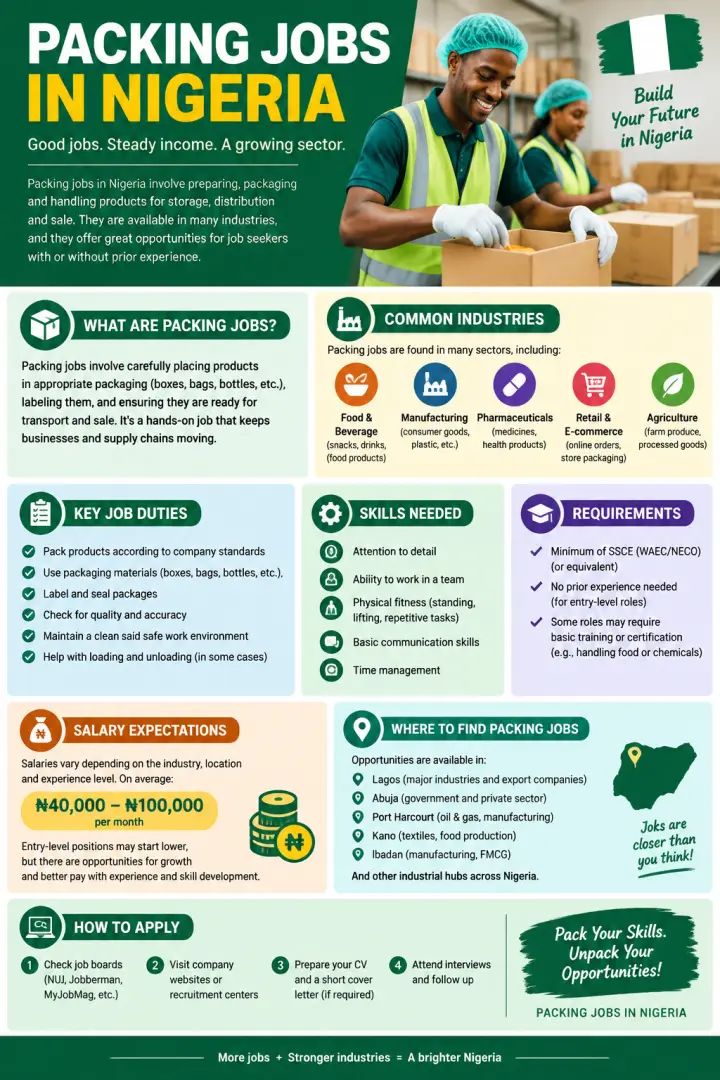
In a factory, you might be standing by a conveyor belt putting sachets of seasoning into cartons. Or sealing bottles of water. Or stacking cartons of noodles onto pallets. In a warehouse, it's more about picking items for an order, wrapping them, labelling the box and passing it on for dispatch.
Some of the common types:
- Factory line packers (food, drinks, soap, cosmetics, plastics)
- Warehouse packers for online stores and distributors
- Dispatch and loading packers who sort stuff for delivery riders and trucks
- Market and shop packers, usually in bigger supermarkets or wholesale spots
- Pharmacy and medical supply packers (these usually want a bit more care and sometimes some training)
Same word, very different days.
Where the jobs actually are
Location matters more than people think. You can't just wake up in a quiet town and expect ten packing vacancies to be waiting.
Lagos is the obvious one. Ikeja, Oshodi, Apapa, Ikorodu, Amuwo-Odofin, Agege. Industrial areas are packed with small and big companies that always need hands. Just across the border into Ogun State, you've got Sango Ota, Agbara and the Ota axis, where a ton of factories sit. Lots of people live in Lagos and commute there, which is its own story (traffic, ah).
Beyond that, think Kano, Onitsha and Aba for trading and light manufacturing, Port Harcourt for oil-related supply work, and Abuja for distribution and retail. Ibadan has some factory work too.
Not gonna lie, Lagos has the most openings. It also has the highest cost of living, so don't just chase the volume without doing your maths.
How much do packers get paid?
Honestly, it varies a lot. The national minimum wage is ₦70,000 a month, but not every small employer follows it, and plenty of casual or contract roles pay by the day.
From what I've seen, entry-level packers in decent companies land somewhere between ₦70,000 and ₦120,000 monthly. Daily-paid casual work can be around ₦3,000 to ₦6,000 depending on the place and how heavy the work is. Supervisors and team leads earn more, sometimes a lot more, especially in bigger factories with overtime.
Small shops and unregistered outfits? Could be lower. Could be way lower. Ask the question before you accept anything.
Also ask about overtime, transport allowance, lunch, and whether they pay on time. A salary that arrives three weeks late isn't really the salary you were promised.
Do you need qualifications?
Usually no. Most places want you to have at least an SSCE (WAEC or NECO), and some don't even care about that for casual roles. What they care about is whether you show up, follow instructions and don't damage goods.
That said, a few things help you stand out:
- You can count and read labels without mistakes
- You're okay standing for long hours
- You can lift moderate weight (usually 10 to 25 kg, sometimes more)
- You've got a clean record and a guarantor if they ask
- Basic phone skills, because some warehouses scan barcodes
Food and drug companies may ask for a medical test. Don't panic about it. It's normal, since they don't want sick people handling products people will eat or swallow.
Finding vacancies without getting scammed
Okay, this is the part I feel strongly about.
Job scams in Nigeria are everywhere. A random WhatsApp message says there's a packing job in a big company, you just need to pay ₦5,000 for registration, ₦10,000 for uniform, something for a medical. Don't do it. A real employer doesn't charge you to work for them. Ever.
So where do you look?
- Job sites like Jobberman, MyJobMag and Indeed Nigeria
- Company websites and their official social media pages
- LinkedIn (yes, even for packing roles, some warehouse managers post there)
- Staffing agencies that are properly registered
- Word of mouth. Honestly, this still wins a lot of the time
Word of mouth is underrated. Someone working in a factory can often tell you when a new batch of hiring is coming, long before it's posted anywhere. Talk to people. Ask your cousin, your neighbour, the guy who sells recharge cards near the industrial estate.
Red flags worth watching
If they ask for money upfront, run. If the interview is only on WhatsApp with no address given, be careful. If the salary sounds too good for simple work (like ₦300,000 for packing biscuits), it's probably bait. And if the company has no real footprint online or on the ground, check around before you go anywhere.
Visit in person if you can. A real factory or warehouse looks like one.
Getting ready for the application
You don't need a fancy CV, but you need something. One page. Your name, phone number, location, education, and any past work, even if it was selling in your aunt's shop or helping at a warehouse for a month. That counts.
Keep it honest and neat. Typos on a CV are small things that cost people interviews more often than they'd guess.
Bring copies of your certificate, ID (NIN slip, voter's card or driver's licence), passport photographs and a guarantor form if requested. Have them in a folder. Walking in with papers all folded and scattered doesn't scream reliable.
What the interview is like
Short, usually. Sometimes it's just a chat with the supervisor and a quick practical test. They might hand you a few items and ask you to pack them neatly and fast. Or they'll watch how you handle boxes.
They'll ask things like: Can you work night shifts? Are you okay with overtime? How far do you live from here? That last one matters more than you think. If you live two hours away, they know you'll probably be late a lot.
Be straight with them. Dress clean and simple. Closed shoes if you can. Arrive early.
And smile a bit. Seriously, it helps.
The reality of the work
Here's the thing nobody puts in the job ad. It's tiring. You'll be on your feet for 8 to 12 hours, sometimes in a hot building with noisy machines. Targets are real. You might be asked to pack a set number of cartons per hour, and slow work gets noticed.
Is it worth it? Depends on you. For some people it's a stepping stone. For others it's steady income they can plan around, and that matters when everything else feels uncertain.
Few things that make it easier:
- Wear comfortable shoes (this is non-negotiable)
- Drink water, even when you're busy
- Learn the fast way to fold, tape and stack, because speed comes from technique, not rushing
- Protect your back when lifting. Bend your knees. People ignore this and regret it
- Keep your hands and tools clean, especially in food or pharma packing
Moving up from the packing line
Don't plan to pack boxes forever unless you want to. Packers who pay attention can move into quality control, inventory, dispatch coordination, or line supervision. These need a bit of extra learning but the pay jumps.
Watch what the store keeper does. Ask how stock is counted. Offer to help check delivery notes. Managers notice who's curious, and in my experience, that's usually the person who gets the next opening.
Some people also use the income to start their own small thing on the side, like repackaging foodstuff, selling in bulk, or running a little packaging business. It's not an overnight thing but it's possible, and knowing how packing and labelling works gives you a head start.
Contract, casual, permanent: know which one you're in
A lot of packing roles are through staffing agencies, so you're technically employed by the agency, not the factory. That's not automatically bad. But it can mean fewer benefits, no pension contributions and a shorter contract.
Ask if there's pension, health cover and a written agreement. If they say no to everything, at least you know where you stand. And if they say yes, ask to see it on paper.
Written is safer. Always.
One last thing
Don't wait for the perfect role. Apply to a few places, learn the ropes, save a little, and keep your eyes open. Packing work might not be your dream, but a stable first step can lead to something much better than sitting at home waiting.
Start with what's near you this week. Check one job board, ask two people you know, and send one clean CV. Small moves, honestly.