

Ask ten people in Lagos what job is always available and at least three will say "driving." They're not wrong. Nigeria runs on wheels. Staff buses, trucks, school runs, Bolt rides, oga's Prado, you name it.
But "always available" doesn't mean "easy to land" or "pays well." There's a big gap between a good driver job and a bad one. So let's talk about what's actually out there.
The main types of driver jobs in Nigeria
Not all driving work is the same. Pay, stress and hours change a lot depending on which one you pick.
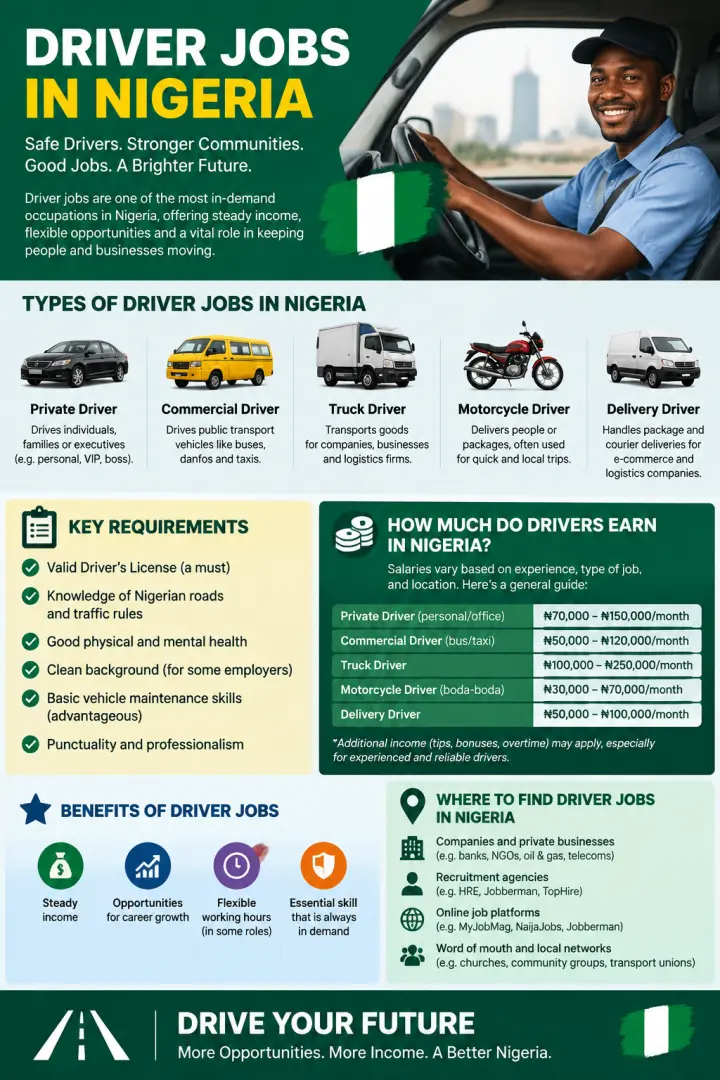
Private or family driver
This is the one most people know. You drive one person or one family. School runs, office, church, the occasional market trip on Saturday.
In my experience, the money here is steady but not huge. Roughly ₦80,000 to ₦150,000 a month in Lagos or Abuja, sometimes more if the family is wealthy or you've got a clean record and good references. Outside the big cities it's usually lower.
The catch? Hours. Some bosses forget that you also have a home to go to.
Company driver
Companies hire drivers for staff transport, deliveries, sales teams and management. You might drive a Hiace bus, a pickup, or a saloon car for an executive.
Pay usually sits between ₦100,000 and ₦250,000, depending on the company. The real win is the extras. Some offer pension, health cover, and overtime. A few even give you a uniform and fuel allowance. Not bad at all.
Ride-hailing (Uber, Bolt, inDrive)
You're your own boss here. Sort of.
Honestly, the earnings can look good on paper and then shrink fast once you subtract fuel, commission, maintenance and the car's daily wear. Lots of drivers work with owned cars. Others rent or do a hire-purchase deal with a car owner, which can eat a big part of what you make.
Do the math before you sign anything. Seriously.
Truck and long-distance driving
This is where the bigger money lives. Trailer drivers, tanker drivers, haulage trucks moving goods from Lagos ports to the North. Monthly pay can go from ₦150,000 to ₦300,000 or higher, plus trip allowances.
It's also tougher. Long nights, bad roads, checkpoints, being away from family for days. Not for everybody.
Bus, school bus and commercial passenger driving
Think BRT, staff shuttles, church buses, school buses and interstate transport companies. Schedules are more regular, which some people love. Interstate companies like to hire experienced drivers with a spotless record, and they check.
Dispatch riders and delivery drivers
Technically riders, not drivers, but a lot of people in this space start with bikes and later move to cars or vans. Food delivery and logistics startups keep hiring. Pay is often per delivery, so your hustle decides your income.
What you need before you apply
Let's keep it simple. Most employers will ask for these:
- A valid driver's licence (and I mean valid, not expired or "in process")
- Some real driving experience, usually 2 to 5 years for better jobs
- A guarantor, sometimes two
- Means of ID, like NIN, voter's card or international passport
- A passport photo and sometimes a recent medical check
- Knowledge of your city's roads and shortcuts
Some bosses also want a police report or character reference. It sounds like a lot, but if you get these ready early, you'll move faster than the next person.
And about the licence. If yours is a few years old, go to FRSC and renew it before you start job hunting. Employers notice little things like that.
Where to actually find these jobs
Here's the thing: the best driver jobs often never get posted online. They travel by word of mouth. A friend's oga needs someone, an estate security man hears about a vacancy, a church member mentions it.
So tell people. Everyone you know. Don't be shy about it.
Beyond that, these places work:
- Job sites like Jobberman, Indeed and MyJobMag, for company roles
- LinkedIn, mostly for corporate and logistics jobs
- Facebook groups for drivers and domestic staff (check each post carefully)
- Logistics company websites, since many hire directly
- Staffing and domestic agencies, if they're properly registered
- Ride-hailing apps directly, if you've got or can get a car
Check recruitment pages for companies like haulage firms, FMCG distributors and courier services. They hire in waves, and a lot of people miss it because they only search for "driver" on Google.
Watch out for scams
Not gonna lie, this part makes me angry. Too many honest drivers lose money to fake recruiters.
If someone asks you to pay for "registration," "uniform," "training" or "job placement" before you've even met the employer, be careful. A real employer doesn't charge you to work for them. Some legit agencies do take a fee, but it should be clear, written down, and from a place you can visit in person.
A few red flags:
- Salary that sounds too good (₦500,000 for a basic family driver job? Come on)
- Interviews only on WhatsApp, no office address
- Pressure to pay today or lose the slot
- No written agreement or contract
If your gut says something's off, listen to it.
How to stand out when you apply
Most applicants show up with a licence and a smile. That's fine, but it won't separate you from the crowd.
Bring a short list of past employers with phone numbers. Let them know it's okay to call. If you've driven for the same family for six years, that says more about you than any CV could.
Also, be neat. Clean clothes, clean car if it's a trial drive. People judge. It's just how it is.
Learn the basics of car care too. Checking oil, tyre pressure, coolant, those small things. A driver who spots a problem early saves the boss money, and bosses remember that when it's time to raise salary.
Oh, and get comfortable with a smartphone and maps. Google Maps, Waze, even basic WhatsApp for sending updates. A lot of the older drivers I know resist this, and it costs them better offers.
Can you make real money as a driver?
Yes. But it takes some thinking.
The drivers who do well aren't always the ones who drive the longest hours. They're the ones who pick the right type of job, stay long enough to build trust, and add skills over time. Defensive driving training, a heavy-duty licence, manual and automatic experience, maybe even basic mechanical knowledge.
Some move from private driving into company roles. Others go from ride-hailing into owning two or three cars and hiring other drivers. That takes years and discipline, plus a bit of luck, but I've seen it happen.
And the ones who burn out? Usually they chase quick cash, ignore rest, and skip car maintenance until something breaks. Don't be that person.
Negotiating pay and terms
Ask questions before you accept. How many hours a day? Is overtime paid? Who pays for fuel and repairs? What happens if the car gets damaged? Is there leave? Is there a salary review?
It feels awkward to ask, I know. But if it's not agreed at the start, it becomes a fight later.
If possible, get it in writing. Even a simple signed note is better than nothing.
Final thoughts before you start applying
Driving is honest work, and Nigeria will need drivers for a long time. Whether you want a quiet family job, a corporate role, or a long-haul gig, there's space for you.
Get your documents sorted this week. Tell five people you're looking. Then start applying, carefully, and never pay to get hired.