

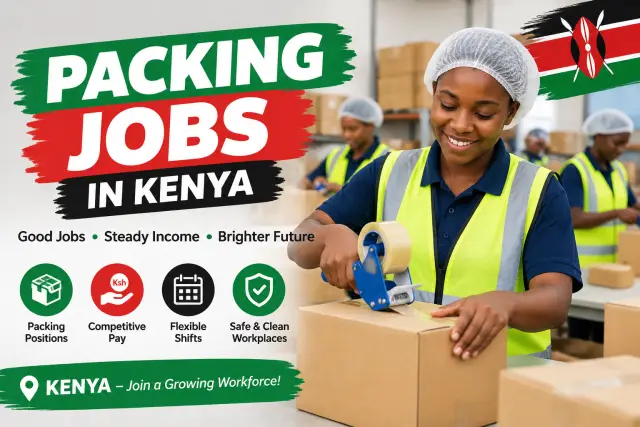
Most people think packing jobs are just for folks with no other options. Honestly, that's not true. I've seen people start on a packing line in Athi River and end up as supervisors within two years.
So let's talk about what these jobs really look like in Kenya. The good, the boring, and the sketchy.
What does a packer actually do?
Depends where you land. In a factory, you're standing at a conveyor belt putting biscuits, soap, cooking oil or tea into boxes. In a supermarket, you might be packing shelves or bagging goods at the till. At a flower farm, you're bunching stems and sealing them for export.
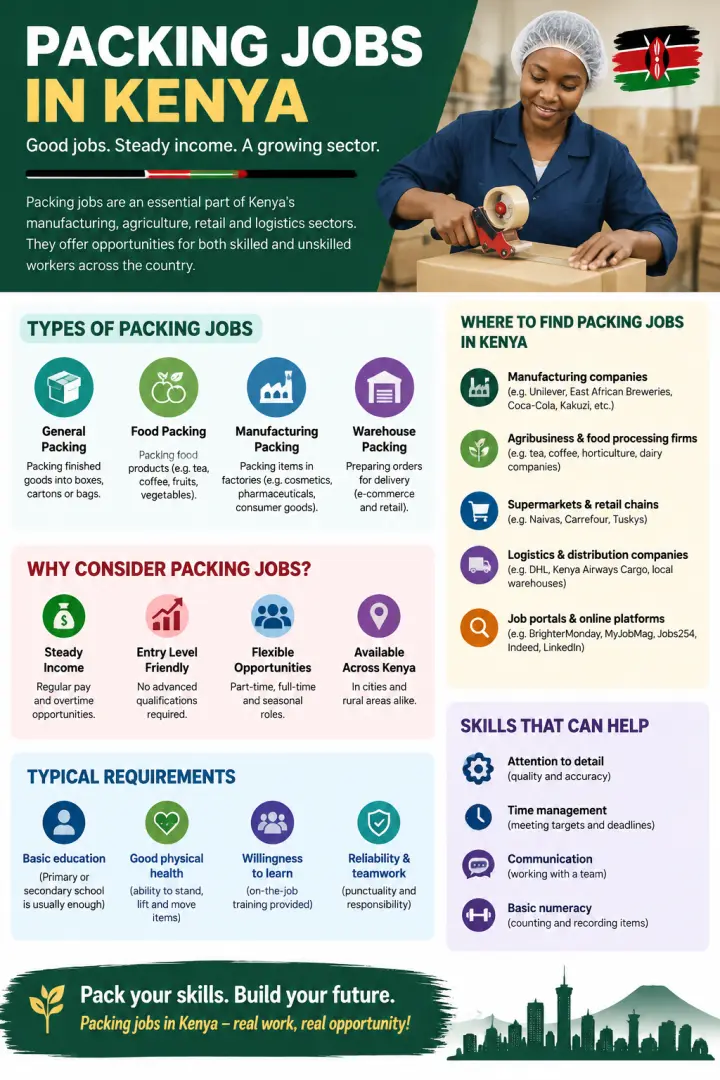
Then there's warehouse packing. That's the one tied to online shopping and courier companies. You pick an order, wrap it, label it, and move to the next one.
It's repetitive. Not gonna lie, you'll get bored. But it's steady work, and in a country where jobs are hard to find, steady matters.
Where the jobs are
Location matters a lot here. Most packing work sits where the factories are.
- Nairobi's Industrial Area, Embakasi and Ruaraka – food, plastics, detergents, printing
- Athi River and Mlolongo – lots of manufacturers and EPZ companies
- Thika and Ruiru – beverages, textiles, packaging companies
- Naivasha – flower farms, mostly for export
- Mombasa – port-related packing, cashew and spice processing, container loading
- Kericho and parts of Nandi – tea packing
- Kisumu and Eldoret – fewer, but there are grain, fish and dairy packers
If you live far from any of these, moving might be the real step. Rent near Mlolongo or Ruiru is cheaper than central Nairobi, by the way. A lot of packers choose it for that reason.
The money, since everyone wants to know
Let's be real. Packing doesn't make you rich.
Permanent staff in cities usually start around the minimum wage for unskilled workers, which is a bit over KSh 16,000 a month in Nairobi, Mombasa and Kisumu (the Ministry of Labour updates this, so check the latest figure). Some companies pay more. Some, sadly, pay less and hope you don't know the law.
Casual work is different. You might get KSh 500 to 800 a day, sometimes more at peak times like December or before Ramadan when food companies rush orders. Overtime can bump your pay quite a bit if the factory is busy.
Know your rights though. Your employer should be deducting and remitting NSSF, SHA and the housing levy. If they're deducting money but you can't find it on your statement, ask questions. Early.
What you need before you apply
Nothing fancy. But you'd be surprised how many people get turned away over missing paperwork.
- National ID (a copy and the original)
- KRA PIN certificate
- NSSF number and SHA number, if you have them
- KCPE or KCSE certificate – most places want at least primary, many want Form Four
- Passport photos
- A simple CV, one page is fine
- Certificate of Good Conduct (some companies ask for it, it costs around KSh 1,050 from the DCI)
Food companies often want a medical certificate too, the food handler type, from a county public health office. Get it before you start applying and you'll look ready.
Finding the actual openings
Online is easiest. BrighterMonday, MyJobMag, Fuzu and Corporate Staffing post packing roles regularly. Set an alert with words like "packer", "production operator" and "warehouse assistant." Companies don't always say "packer."
But here's the thing. A lot of hiring never goes online. Factories in Mlolongo or Industrial Area put a notice at the gate. Others just tell the security guard to send people to HR on Monday morning. Walking in can work, especially if you dress neat and carry your documents in a folder.
Facebook groups and WhatsApp groups for job seekers in your area are worth joining too. Quality varies wildly, so take everything there with a pinch of salt.
And then there are recruitment agencies. Some are legit, some aren't. Which brings me to the next part.
Scams. Please read this bit twice
If anyone asks you to pay to get a packing job, walk away. Registration fees, "uniform fees," "medical fees" paid to an individual's M-Pesa. All red flags.
A real employer doesn't charge you to work for them. Full stop.
Other warning signs:
- Job offers that come with no interview, ever
- A Gmail or Yahoo address pretending to be a big company's HR
- Salaries that sound way too good for simple packing work
- Pressure to pay today because "slots are closing"
Packing jobs abroad deserve extra caution. Gulf countries have had plenty of horror stories involving Kenyans. If you're going that route, check that the agency is registered with the National Employment Authority (NEA) and read the contract before you sign anything. Ask for it in writing. If they dodge, that tells you plenty.
How to do well in the interview
Packing interviews are usually short. Sometimes it's a chat with HR and a quick practical test, like packing a few items fast without damaging them.
What they care about is pretty simple. Do you show up on time? Can you follow instructions? Will you stay past the first month?
Retention is a big headache for factories, so say you want stability. If you can work shifts, say so. If you can handle night shift, even better, because those spots are harder to fill.
Wear closed shoes. Clean clothes. It sounds small, but I've heard supervisors say that's how they sort candidates in the first thirty seconds.
The first few weeks are rough
Standing for eight to ten hours kills your legs. Your back will complain. Get proper shoes, not the cheap flat ones.
Speed matters, but accuracy matters more. Pack fast and send the wrong product, and you'll hear about it. Pack slowly but correctly, and you'll get faster naturally.
Talk to the people who've been there a while. They know which supervisor is fair, which line is easiest, and when contracts usually get renewed. That kind of info isn't written anywhere.
Can this turn into a real career?
Yes, if you play it right. Not everyone does, and that's fine.
Here's what I've seen work. Start as a packer. Learn the line. Offer to help with stock counts or quality checks. Then ask about moving to line leader, store clerk, forklift operator or quality control assistant. Forklift licences and basic training courses can raise your pay noticeably, and some companies will even sponsor them if you've proven yourself.
Others use packing work as a bridge. They save money, then start a small business or go back to school part-time. Nothing wrong with that either.
Casual or permanent, which one?
Casuals get daily pay and little security. Permanent staff get a contract, leave days and statutory deductions.
Under Kenyan law, a casual who keeps working beyond a month can be treated differently, since the Employment Act says they may be entitled to a written contract and terms of a monthly-paid employee. Lots of employers ignore that, and lots of workers don't know it. So read up, or talk to a union rep if one exists at your workplace.
Still, don't turn down casual work if you need money now. Many permanent hires start as casuals. Just keep your eyes open.
Small stuff that makes a difference
Keep a copy of your contract. Take a photo of it on your phone, even.
Check your payslip every month. Mistakes happen, sometimes on purpose.
Save a little, even KSh 500 a week. If you lose the job suddenly (it happens), you'll be glad you did.
And be nice to the guard at the gate, honestly. That guy has watched hundreds of people come and go, and he knows when HR is hiring.